
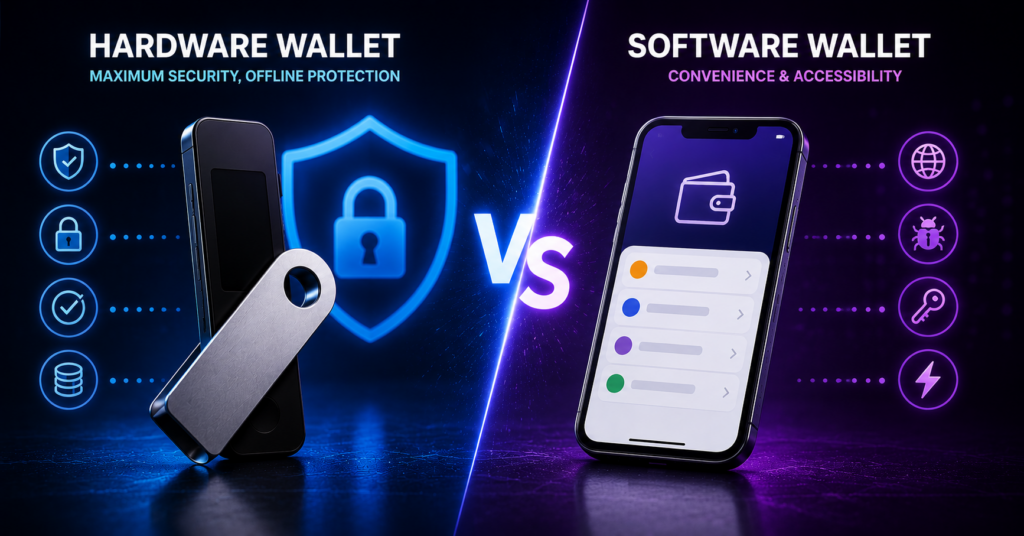
Choosing between a hardware wallet and a software wallet is really a choice between convenience and security. Both can be useful, but they are best suited to different amounts, habits, and risk levels.
A software wallet is often easier for everyday activity, while a hardware wallet is generally safer for storing meaningful crypto holdings because private keys stay offline.
This guide is published by Cryptnox, which makes a hardware wallet.
| Feature | Software wallet | Hardware wallet |
|---|---|---|
| Key storage | Private keys are stored on an internet-connected phone, browser, or computer. | Private keys are generated and stored inside a dedicated offline device. |
| Internet exposure | Regularly connected to the internet and apps. | Keys remain offline even when transactions are prepared on a connected device. |
| Malware risk | More exposed to phishing, malicious extensions, clipboard attacks, and infected devices. | Lower risk because transactions must be approved on the wallet and keys are not exposed to the computer or phone. |
| Cost | Usually free to install, with possible network and service fees. | Requires buying a dedicated device or card. |
| Best for | Small balances, daily spending, fast DeFi access, testing dApps, and learning. | Longer-term storage, larger balances, and users who want stronger key protection. |
Keys stay offline. A hardware wallet keeps private keys inside the device, instead of storing them directly on an internet-connected phone or computer.
Transactions are confirmed on the wallet. The wallet signs transactions only after user approval, reducing the chance that malware silently moves funds.
No remote attack surface for the private key. Since the private key does not sit in a browser extension or mobile app, an attacker cannot simply extract it over the internet.
Secure hardware adds another layer. Cryptnox uses an EAL6+ certified secure element, and private keys are generated inside and never leave that secure element.
Small everyday amounts. If you only keep a modest balance for payments, testing, or quick swaps, a software wallet can be practical.
Fast dApp and DeFi activity. Browser and mobile wallets are often convenient for frequent signing, connecting to new protocols, or experimenting with on-chain tools.
Learning and development. Software wallets are useful for trying new networks, testing dApps, and understanding how crypto transactions work before committing larger funds.
Many users treat a hardware wallet like a savings account and a software wallet like a spending account. Keep meaningful holdings on the hardware wallet, then move smaller amounts to a software wallet when you need quick access.
Cryptnox fits this approach in a card format: tap the NFC smart card to your phone, use the free Cryptnox app on iOS or Android, and connect to dApps through WalletConnect or MetaMask when needed.
No wallet is impossible to attack, but a hardware wallet greatly reduces common remote risks because the private key is kept off the internet. The main risks are usually physical theft, weak PIN practices, phishing, or approving a malicious transaction without checking it carefully.
With the Cryptnox Crypto Hardware Wallet Dual-Card Set, you set up both cards yourself in the app during a paired ceremony. The seed is generated inside both secure elements and written to both cards, so the second card is the ready-made backup. There is no 24-word recovery phrase to write down by default. Advanced users can instead import an existing 12 or 24-word BIP39 seed, but that is an optional path.
For very small balances, a software wallet may be enough. A hardware wallet becomes more compelling when the amount would be painful to lose, or when you want stronger protection from malware and phishing. Cryptnox is €49.90 and comes in a credit-card-sized NFC smart-card format, which may make hardware wallet security more accessible. You can also compare options in our hardware wallet comparison.
Software wallets are convenient and useful for active crypto use. Hardware wallets are better suited for protecting meaningful holdings because private keys stay isolated from internet-connected devices. For many people, the most practical answer is to use both.
Buy the Cryptnox hardware wallet card
For a broader overview, read our hardware wallet comparison.
For banks, fintechs and other businesses that want to issue their own cards, Cryptnox C-WaaS is blockchain-native card scheme infrastructure: EAL6+ secure-element cards, issuer-controlled authorisation and direct on-chain settlement, while the cardholder’s key stays in the card, the same self-custody this article recommends.
Learn about C-WaaS