
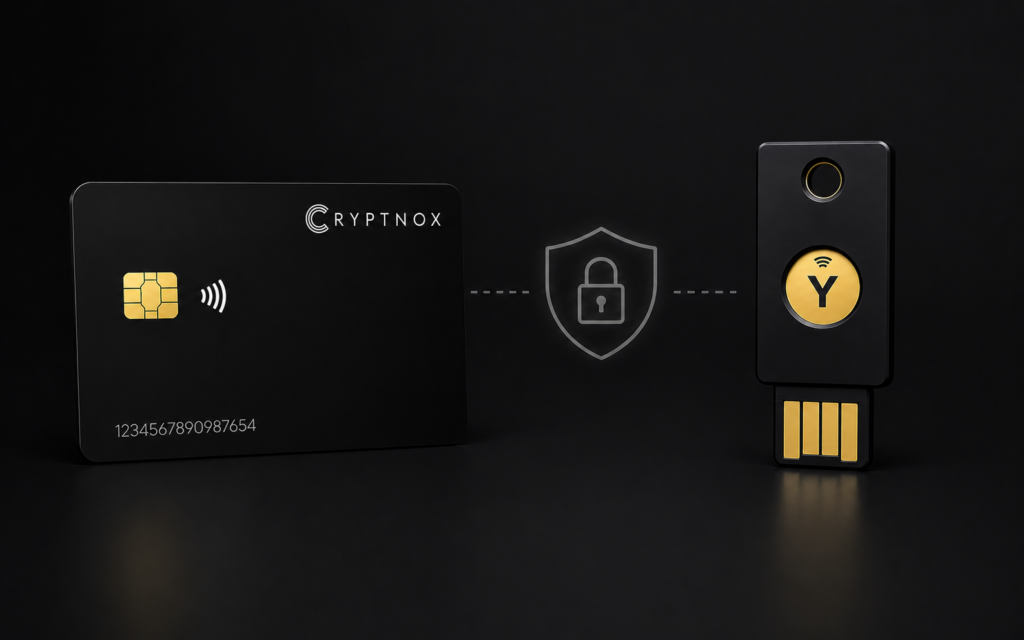
When enterprises compare a FIPS PIV card with a YubiKey PIV applet, they often focus on the obvious points: algorithms, form factor, price and tool support. That comparison is useful, but it misses the deeper security difference.
Both models can expose PIV-compatible slots. Both can hold RSA or elliptic-curve credentials. Both can be used by operating systems and middleware that understand PIV smart cards. The real difference is the smart card life cycle: how the credential moves from a blank secure element to an issued identity card that can be used for Windows logon, RDP, PKI authentication or enterprise signing.
For high-assurance deployments, that life cycle is not a minor operational detail. It determines who controls policy, who can initialize the credential, which actions are possible after issuance, and whether the final state is reversible.
A YubiKey PIV applet is designed for convenience. The device arrives from Yubico with the PIV application already initialized. The user or administrator can immediately change the PIN, change the PUK, generate keys, import certificates and start using common Yubico tools.
A standards-based FIPS PIV card, such as a Cryptnox PIV card deployment, separates the process into controlled phases:
That split is the core distinction. The YubiKey model prioritizes a turnkey experience. The issuer-controlled PIV card model prioritizes policy ownership, auditability and separation of duties.
PIV stands for Personal Identity Verification. In the United States federal identity ecosystem, FIPS 201 defines the requirements and characteristics of interoperable PIV credentials, and NIST SP 800-73 defines the smart card interfaces used to retrieve and use PIV credentials.
In practical enterprise terms, a PIV smart card can be used for:
A PIV card is therefore not simply a storage device for private keys. It is a structured identity credential with standardized objects, slots, certificates and access rules.
Pre-personalization, often shortened to pre-perso, is the issuer or manufacturing phase.
It creates the empty structure of the PIV card:
9A, 9C, 9D and 9ENo user identity is issued at this point. No employee certificate is written. No end-user PIN needs to be known. The issuer is simply defining what the card will be allowed to do during its lifetime.
Personalization, or perso, is the enrollment phase.
This is where the credential becomes useful for a person, device or role:
The important point is that personalization should not be able to weaken the policy created during pre-personalization. For example, an operator should not be able to turn a PIN-required signing key into a no-PIN key after issuance.
The life cycle determines the trust boundary.
In an issuer-controlled PIV card model, the enterprise decides the security posture before credentials are issued. That can include:
That matters for enterprise, government and regulated environments because the card becomes a policy-enforcing device, not just a key container.
A turnkey PIV token can still be secure and useful, but the policy model is largely predefined by the vendor. An issuer-controlled PIV card lets the enterprise define the structure and prove that structure through repeatable issuance scripts or YAML profiles.
The Cryptnox model is designed around issuer control. The card life cycle can be managed through the cryptnox-id CLI, with separate commands for factory operations and operational personalization.
Cryptnox PIV cards run a PIV applet on an NXP secure element. The PIV applet is built from the same codebase that was certified under FIPS 140-3 (NIST CMVP certificate #5280). It is not deployed in the configuration covered by that certificate, and Cryptnox does not claim any FIPS certification at this stage. The secure element chip is Common Criteria EAL6+.
The key idea is simple: the card should be easy to use after issuance, but the security policy should be controlled before issuance.
During pre-personalization, the issuer loads the PIV structure onto the card. In a Cryptnox deployment, this can be driven by a profile that describes the intended card policy.
Example profile structure:
name: cryptnox-default
admin: { key_ref: "9B", mechanism: AES256 }
pin: { min: 6, max: 8, retries: 3, charset: numeric }
puk: { min: 8, max: 8, retries: 3 }
keys:
 - ref: "9A" # PIV Authentication
 mechanism: ECCP256
 role: AUTHENTICATE
 contact: PIN
 contactless: NEVER
 - ref: "9C" # Digital Signature
 mechanism: ECCP256
 role: SIGN
 contact: PIN
 contactless: NEVER
A command such as the following loads the profile:
cryptnox-id factory piv preperso load-config --profile cryptnox-default --default-keysThis phase defines the card’s architecture: verifiers, containers, key objects and access rules. For high-assurance deployments, administrative operations can be restricted to the contact interface so that pre-personalization is not performed over NFC.
This is where the Cryptnox model differs strongly from a consumer token model. The issuer is not merely accepting a vendor’s pre-built PIV structure. The issuer can define the structure and make it reproducible.
After pre-personalization, the card can be personalized for a specific user or use case.
Example flow:
cryptnox-id piv perso set-pin
cryptnox-id piv perso set-puk
cryptnox-id piv perso generate-key --slot 9C --algorithm ECCP256 --out 9c.pub.pem
cryptnox-id piv perso self-sign-cert --slot 9C --subject "CN=Test User" --public-key 9c.pub.pem --out 9c.crt.pem
cryptnox-id piv perso import-cert --slot 9C --cert 9c.crt.pem
cryptnox-id piv perso generate-chuid
cryptnox-id piv perso generate-ccc
cryptnox-id piv perso smoke-test --slot 9C --algorithm ECCP256
At this point, the operator can issue a credential, but the operator remains constrained by the structure defined earlier.
This is useful for enterprise issuance because security teams can define a standard card profile, while helpdesk, HR, IT or an enrollment station can personalize individual cards without redefining the underlying rules.
The final step is to lock the applet into a secured state.
cryptnox-id factory piv preperso finalize --i-understand-this-is-irreversible --default-keysFinalization should be treated as a manufacturing or issuer-controlled action. Once performed, pre-personalization commands should be blocked. This gives the issuer a strong one-way boundary between “card setup” and “issued credential.”
For enterprise governance, this is important: a finalized card is not just configured; it is locked into the intended policy state.
The YubiKey PIV experience is intentionally simpler.
A YubiKey arrives with the PIV application already initialized. The administrator can use tools such as ykman or yubico-piv-tool to change access codes, generate keys and import certificates.
Example commands:
ykman piv access change-pin
ykman piv keys generate 9c pub.pem
ykman piv certificates generate 9c pub.pem --subject "CN=Test User"
That is a major advantage for many users. There is no separate issuer pre-personalization profile, no factory namespace and no irreversible finalize command exposed to the enterprise.
The trade-off is that the PIV life cycle is largely vendor-defined. The user gets an excellent turnkey PIV experience, but the enterprise does not own the full structure of the card in the same way it would with an issuer-controlled PIV card program.
| Question | Issuer-controlled FIPS PIV card | YubiKey PIV applet |
|---|---|---|
| Who defines the PIV structure? | The issuer, using a controlled profile | Yubico, at factory initialization |
| Is there a separate pre-personalization phase? | Yes | Not exposed to the user |
| Is personalization separate from structure creation? | Yes | Mostly collapsed into end-user/admin setup |
| Can the issuer define per-slot policy? | Yes, depending on profile and applet capabilities | Limited to YubiKey-supported policies |
| Can the enterprise define contact/contactless restrictions? | Yes, in the card policy | Vendor-defined behavior and supported settings |
| Is there a one-way finalization step? | Yes, in the issuer-controlled model | No equivalent issuer finalize step |
| Is it convenient for individual users? | Yes with CLI quickstart, but more structured | Very convenient out of the box |
| Is it suitable for controlled issuance programs? | Strong fit | Fit depends on whether vendor-defined lifecycle is acceptable |
| Tooling model | cryptnox-id CLI, OpenSC, Windows smart card support | YubiKey Manager, yubico-piv-tool, OpenSC, Windows smart card support |
| Best fit | Enterprises, government identity, custom card programs, badge convergence | Individual users, developers, IT teams wanting turnkey deployment |
The YubiKey PIV model is popular because it is practical.
For an administrator or developer, the value is obvious:
For many organizations, that is exactly what they need. A fast, well-supported, off-the-shelf token can be the right answer.
A FIPS PIV card program is different. It is less about buying a finished token and more about controlling an identity credential life cycle.
That model is especially relevant when the organization needs:
In other words, the FIPS PIV card model is stronger when the card is part of an enterprise identity system rather than just an individual authenticator.
The goal is not to make the secure life cycle complicated for daily users. The goal is to keep issuer control while offering simple operational commands.
That is where the cryptnox-id CLI matters.
A quickstart command can detect the card state, plan missing steps and run the full sequence:
cryptnox-id piv quickstart --include-preperso --profile cryptnox-default --default-keysA complete flow can include:
The user experience becomes closer to a turnkey token, but the issuer still controls the card policy.
Many enterprise PKI workflows issue credentials as a .pfx or .p12 file. A practical CLI should make that easy:
cryptnox-id piv perso import-p12 --slot 9A --p12 user.pfx --default-keysThis makes the card easier to integrate into existing Windows, Active Directory, VPN or internal PKI enrollment processes.
Windows smart card logon has specific certificate and key-usage expectations. For Windows domain logon or RDP, the PIV authentication slot and certificate profile must be compatible with the Microsoft environment.
A dedicated profile can be used for Microsoft-oriented enrollment:
cryptnox-id piv quickstart --profile ms-logon --include-preperso \
 --slot 9A --cert-mode csr --csr-out 9a.csr.pem --default-keys
The CSR can then be submitted to the enterprise CA, and the issued certificate can be imported back onto the card.
This is the point where the Cryptnox model becomes commercially interesting: it can offer the practical experience administrators expect from a YubiKey-style deployment while preserving the issuer-controlled life cycle required by more demanding identity programs.
Organizations using Active Directory, certificate services and smart card logon may want a controlled card profile for every employee. A PIV smart card can be issued with the correct certificate profile, PIN policy and slot configuration.
RDP, administrator accounts and privileged workstations often need stronger authentication than passwords or push-based MFA. PIV credentials can support certificate-based access with physical possession of the card.
Government, defense, healthcare, finance and critical infrastructure deployments often care about more than “does it work?” They need documented issuance steps, repeatable profiles and controlled security policies.
A smart card can combine logical access with physical-access technologies. For example, one card can support PIV for PKI authentication, FIDO2 for phishing-resistant web login and MIFARE DESFire for access control, depending on the applets and deployment profile.
The converged Cryptnox FIDO2 + PIV + MIFARE card is a single-card example of this convergence.
Banks, fintechs, public agencies and enterprise identity teams may want a branded card with a controlled issuer process instead of an off-the-shelf USB token. This is where the card form factor and issuer-controlled PIV life cycle create value.
Shop Cryptnox PIV cards: compare the full Cryptnox PIV card range — a PIV-only card, a FIDO2 + PIV card, and the converged FIDO2 + PIV + MIFARE card — each with on-card RSA-4096 and an issuer-controlled life cycle.
Related reading: FIDO2, PIV and MIFARE DESFire EV3 16K on one enterprise smart card — how FIDO2, PIV and MIFARE DESFire EV3 16K coexist on one printable employee badge without merging the three functions.
A YubiKey can run a PIV-compatible application and expose PIV slots for certificates and private keys. It is often used for smart card logon, digital signing and certificate-based authentication. However, its life cycle is vendor-initialized rather than issuer-defined through a separate pre-personalization phase.
PIV pre-personalization is the phase where the issuer creates the structure of the card: verifiers, containers, key slots and access rules. It happens before a user credential is issued.
PIV personalization is the phase where the card receives user-specific material such as PINs, keys, certificates and identity objects.
Pre-personalization matters because it defines what the card can and cannot do. Once the structure is created and finalized, later operators should not be able to weaken the security policy.
Yes. PIV smart cards can be used for Windows smart card logon when the certificate, key usage, EKU, UPN and domain trust requirements are correctly configured.
Yes. RDP can use smart card authentication in an Active Directory environment when the card, certificate and domain infrastructure are configured correctly.
No. The better option depends on the deployment. YubiKey PIV is excellent for turnkey use. An issuer-controlled FIPS PIV card is better when an organization needs control over issuance, policy, life cycle and card finalization.
The Cryptnox advantage is the ability to deliver a card-based, issuer-controlled smart card life cycle while still offering a CLI experience that can simplify enrollment, certificate import and Windows logon deployment.