
At first glance, a mobile crypto wallet app may look like a normal fintech application: a user opens the app, checks a balance, scans an address, confirms a transaction and signs it.
In reality, developing and maintaining a secure crypto wallet app is far more complex.
A crypto wallet app must operate in one of the most hostile environments in consumer software: the user’s smartphone. The phone may be rooted or jailbroken. Malware may be present. Debugging tools may be attached. Screen content may be captured. Clipboard data may be stolen. Network traffic may be intercepted. API calls may be replayed. Fake apps may try to imitate the real wallet.
For a standard software wallet, the challenge is even greater because the private keys are usually generated, stored or used directly on the phone.
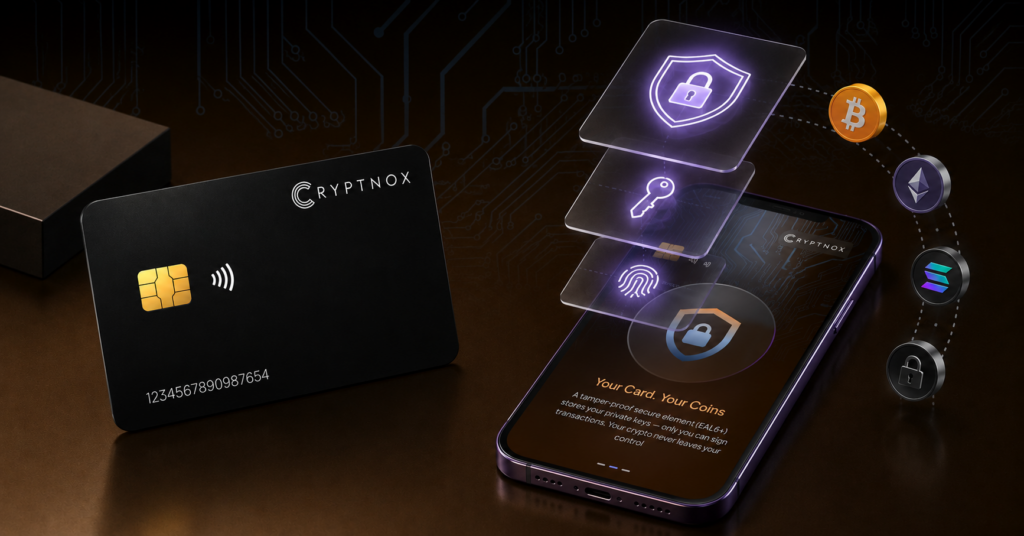
In the Cryptnox architecture, the model is different: the mobile app communicates with an external hardware wallet smartcard over NFC. The private keys remain inside the secure hardware. The mobile phone acts as the user interface, transaction builder, network gateway and secure communication bridge.
This dramatically improves the security model, but it also introduces another layer of engineering complexity: encrypted NFC communication with the external hardware wallet.
A traditional mobile crypto wallet usually stores sensitive wallet material on the phone, protected by the operating system, biometric authentication, app sandboxing and sometimes secure enclave or keystore technologies.
A hardware-wallet-based mobile app has a different role.
The phone should not become the root of trust. Instead, the external hardware wallet is the trust anchor. The app must prepare transactions, display information, collect user intent, communicate securely with the card and submit signed transactions to blockchain networks or backend services.
In the Cryptnox case, the mobile app does not simply “hold a wallet.” It operates as a secure companion to a smartcard-based hardware wallet.
This means the mobile app must handle:
The complexity is therefore not only in the wallet interface. It is in the entire trust chain between the user, the phone, the hardware wallet card, the backend API and the blockchain network.
A serious crypto wallet cannot treat Android and iOS as identical platforms. They have different security models, different APIs, different NFC restrictions and different anti-tampering techniques.
Android gives developers more flexibility, but it also exposes the wallet to a wider range of device fragmentation and attack scenarios.
Android devices vary significantly by manufacturer, OS version, security patch level, NFC implementation and system integrity. Rooting is common in some user groups, and Android applications are easier to decompile than iOS applications.
This makes Android protection especially important.
For Android, a secure wallet should consider:
In the Cryptnox implementation, Android-specific hardening includes FreeRASP SDK integration, R8 code minify and shrink resources, debugger blocking in release builds, Play Integrity API, app switcher protection for sensitive screens and clipboard clearing after mnemonic exposure.
iOS provides a more controlled environment, but it is not automatically secure.
Jailbroken devices, instrumentation frameworks, malicious profiles, screen capture risks, compromised backups and reverse engineering remain relevant threats. iOS also has its own platform-specific security services, such as App Attest, DeviceCheck, Keychain services and Secure Enclave-backed mechanisms.
For iOS, a secure wallet should consider:
In the Cryptnox implementation, iOS-specific hardening includes FreeRASP SDK integration, debugger blocking in release builds, App Attest API, DeviceCheck API, telemetry data collection, sensitive screen protection and clipboard clearing.
A secure crypto wallet must start with a clear threat model. Without one, security becomes a checklist rather than a system.
For a mobile crypto wallet connected to an external hardware wallet, the main threats include:
The user’s phone may be rooted, jailbroken or infected with malware. An attacker may try to intercept NFC communication, manipulate transaction data or automate wallet actions.
The app must assume the device may not be fully trustworthy.
Attackers may decompile the app, inspect APIs, extract constants, understand APDU flows or identify backend endpoints.
This is why code obfuscation, R8 minification, symbol stripping, native C/Rust logic and anti-debugging are important.
Tools such as Frida, Xposed, LLDB or other runtime instrumentation frameworks can be used to modify app behavior during execution.
A secure wallet should detect or block debugging in release builds and use runtime protection to identify tampering.
The attacker may try to alter the recipient address, amount, token contract address, chain ID or transaction payload before signature.
With an external hardware wallet, the card should verify or participate in the secure signing process. The mobile app should never be blindly trusted as the source of transaction truth.
NFC communication between the phone and the hardware wallet must be protected. Without secure channel protection, an attacker could attempt to intercept, replay or manipulate APDU commands.
In the Cryptnox architecture, this is why the APDU command builder, Secure Channel Protocol and certificate validation are critical.
The mobile app communicates with backend APIs. Attackers may attempt to call those APIs directly, replay requests, spoof devices, abuse endpoints or bypass app controls.
API protection must include device integrity checks, app attestation, rate limiting, token-based access, backend verification and potentially Cloudflare Workers or similar edge protection.
Screens showing PIN, PUK, mnemonic or recovery information must be protected from screenshots, app switcher previews and clipboard leaks.
The Cryptnox implementation blocks sensitive app content in the app switcher and clears copied mnemonic data from clipboard history after 60 seconds.
NFC communication sounds simple: tap the card, send a command, receive a response.
In practice, secure NFC communication with a hardware wallet is one of the most complex parts of the system.
The mobile app must communicate with the card using APDU commands. These commands must be carefully structured, encoded, transmitted and validated. The app must handle connection interruptions, partial responses, NFC timing differences, Android/iOS NFC behavior, user movement and device-specific NFC antenna performance.
For a crypto hardware wallet, APDU communication is not just about reading a card. It may involve:
In the Cryptnox implementation, the following components are especially important:
APDU command builder
The app must construct precise commands for the card. Any mistake can cause failed transactions, broken sessions or security issues.
Secure Channel Protocol
Communication between the app and the card must be encrypted and authenticated. This protects sensitive wallet operations from interception or manipulation.
Certificate validation
The app must validate that it is communicating with a genuine Cryptnox hardware wallet and not a fake or cloned device.
PIN and PUK validation workflows
The app must manage authentication without exposing sensitive data or weakening the hardware wallet’s security model.
Transaction-specific encoding
Ethereum and Bitcoin transactions use different encoding, hashing and signing logic. The app must prepare the right data for the card to sign.
This is why a hardware wallet mobile app is not simply a “wallet UI.” It is a secure protocol implementation running on a hostile consumer device.
A crypto wallet that supports multiple blockchains must implement very different transaction models.
Bitcoin transaction signing is not the same as Ethereum transaction signing. Ethereum transaction encoding is not the same as Bitcoin sighash processing. Token transfers, EIP-1559 transactions, RLP encoding, address derivation and chain-specific rules all add complexity.
In the Cryptnox implementation roadmap, sensitive logic includes:
Some of this logic can be moved into C or Rust to make reverse engineering harder and to isolate sensitive processing from higher-level application code. This does not make the app impossible to attack, but it increases the cost and complexity for attackers.
Code obfuscation is often treated as an afterthought in mobile apps. For crypto wallets, it should be part of the core security design.
A crypto wallet app exposes valuable information to attackers:
On Android, R8 code minification and resource shrinking help reduce the readability of the app. Additional obfuscation can make class names, method names and control flow harder to understand.
On iOS, developers should use compiler optimizations, symbol stripping, Swift/Objective-C hardening and, where appropriate, commercial obfuscation tools.
For Cryptnox, code obfuscation is especially relevant because the mobile app communicates with a hardware wallet through a secure APDU protocol. The protocol implementation should not be easy to inspect, clone or manipulate.
Obfuscation is not a replacement for real security. The system must remain secure even if the attacker understands the app. Obfuscation raises the cost of attack, but the real root of trust should remain inside the hardware wallet card and backend verification systems.
A common mistake in mobile wallet development is assuming that the official app is the only client calling the backend API.
In reality, attackers can call backend endpoints directly. They can reverse engineer API calls, replay requests, modify headers, spoof device identifiers or automate abuse at scale.
For a secure wallet ecosystem, API protection should include:
For Cryptnox, API protection via Cloudflare Workers should be seriously considered. A Cloudflare Worker can act as a controlled edge proxy between the mobile app and backend services. It can enforce rate limits, validate request formats, block suspicious traffic, require attestation tokens and reduce direct exposure of backend infrastructure.
The app can request. The backend must verify. The hardware wallet must protect the key.
Runtime protection helps detect when the app is running in a dangerous environment.
In the Cryptnox implementation, telemetry data collection is enabled for both Android and iOS. This is important because security is not only about prevention. It is also about detection.
Useful telemetry signals may include:
Telemetry must be designed carefully. A privacy-focused wallet should collect only what is necessary for security, fraud prevention and reliability. It should avoid unnecessary personal data collection.
Wallet apps often expose extremely sensitive information for a short time. This may include mnemonic phrases, PIN screens, PUK screens, pairing codes or recovery instructions.
The Cryptnox implementation includes two important protections:
Block app contents in the app switcher
Sensitive screens such as PIN/PUK screens and mnemonic screens should not appear in app switcher previews.
Clear copied mnemonic from clipboard history after 60 seconds
Clipboard data is a frequent leakage point. If the user copies a mnemonic or sensitive recovery data, the app should clear it quickly.
These details may seem small, but they matter. Many real-world wallet losses do not come from advanced cryptography attacks. They come from screenshots, clipboard leakage, phishing, malware or poor UX around sensitive data.
Below is a simplified overview of the Cryptnox mobile wallet security implementation and roadmap.
| Security feature | Android | iOS | Status / comment |
|---|---|---|---|
| FreeRASP SDK integration | Yes | Yes | Runtime threat detection and app protection |
| R8 code minify + shrink resources | Yes | No | Android-specific protection |
| Debugger block in release build | Yes | Yes | Prevents basic runtime debugging |
| Play Integrity API | Yes | No | Android device and app integrity |
| App Attest API | No | Yes | iOS app integrity verification |
| DeviceCheck API | No | Yes | iOS device-level risk signal |
| Telemetry data collection | Yes | Yes | Security and reliability monitoring |
| C or Rust crypto logic conversion | Yes | Yes | Sensitive logic moved closer to native layer |
| Code obfuscation | Yes | Yes | Makes reverse engineering harder |
| APDU command builder | Yes | Yes | Required for smartcard communication |
| Secure Channel Protocol | Yes | Yes | Encrypted/authenticated NFC communication |
| Certificate validation | Yes | Yes | Validates genuine hardware wallet/card |
| Cloudflare Workers API protection | Planned | Planned | Edge API protection layer |
| Kill Switch | To discuss | To discuss | Useful for compromised versions or emergency response |
| Block app contents in app switcher | Yes | Yes | For PIN, PUK and mnemonic screens |
| Clear copied mnemonic from clipboard | Yes | Yes | Clear after 60 seconds |
Launching a crypto wallet app is only the beginning.
Maintaining it is often harder than building version one.
The team must continuously handle:
A mobile crypto wallet is not a static product. It is a living security system.
For an external hardware wallet app, maintenance also includes compatibility with the physical card firmware, secure channel updates, APDU changes, certificate updates and card personalization logic.
This is why serious wallet development requires long-term security engineering, not only mobile app development.
The Cryptnox architecture reduces one of the biggest risks of mobile crypto wallets: private key exposure on the phone.
By using an external hardware wallet smartcard, the private keys remain protected inside secure hardware. The mobile app becomes a secure companion that handles user interaction, transaction preparation, NFC communication and network connectivity.
This architecture has major advantages:
But this model also requires advanced engineering. The app must be secure enough to resist manipulation, while the hardware wallet must remain the ultimate trust anchor.
Developing a mobile crypto wallet app is complex because it combines mobile development, cryptography, secure hardware, NFC communication, blockchain transaction engineering, backend API security and operational threat monitoring.
Android and iOS require different security strategies. NFC hardware wallet communication requires secure APDU protocols. Backend APIs must be protected against direct abuse. Sensitive screens and clipboard data must be handled carefully. Code obfuscation, anti-debugging, app attestation and telemetry must be built into the product from the start.
In the Cryptnox model, the external hardware wallet significantly improves the security architecture by keeping private keys inside dedicated secure hardware. But the mobile app remains a critical part of the system. It must be hardened, monitored and maintained continuously.
A secure wallet is not created by one feature. It is created by layers: hardware security, encrypted NFC communication, strong mobile app protection, secure APIs, code obfuscation, runtime detection, careful UX and continuous maintenance.
That is why building a serious crypto wallet app is not just difficult. It is one of the most demanding categories of mobile software development.
Because it runs in one of the most hostile environments in consumer software: the user’s smartphone. The device may be rooted or jailbroken, malware may be present, debugging tools may be attached, screen content and clipboard data may be captured, and API calls may be replayed. The wallet has to stay secure even when the device around it cannot be trusted.
The phone stops being the root of trust. The private keys stay inside the secure hardware of the smartcard, and the mobile app becomes a secure companion that prepares transactions, displays information, collects user intent, communicates with the card over NFC and submits signed transactions. That removes key exposure on the phone, but it adds encrypted NFC communication as a new layer of engineering complexity.
They have different security models, APIs, NFC restrictions and anti-tampering techniques. Android work centres on R8 minification, root detection and the Play Integrity API across a fragmented device base, while iOS relies on App Attest, DeviceCheck, jailbreak detection and Keychain services. Runtime protection, debugger blocking in release builds, code obfuscation and telemetry are needed on both.
The app talks to the card with APDU commands that must be precisely constructed, encoded, transmitted and validated. A single session can involve selecting the applet, opening a secure channel, validating certificates, managing PIN and PUK authentication, sending transaction payloads and handling retries securely, while coping with connection interruptions, partial responses, platform NFC differences and device-specific antenna performance.
No. Obfuscation raises the cost of an attack, but it is not a replacement for real security: the system must remain secure even if the attacker fully understands the app. The root of trust has to stay inside the hardware wallet card and in backend verification.
Attackers can call backend endpoints directly, replay requests, modify headers, spoof device identifiers and automate abuse at scale. API protection therefore needs strong authentication, short-lived access tokens, device integrity and app attestation checks, request signing, rate limiting, certificate pinning and backend-side validation of every sensitive operation. The app can request; the backend must verify; the hardware wallet must protect the key.