
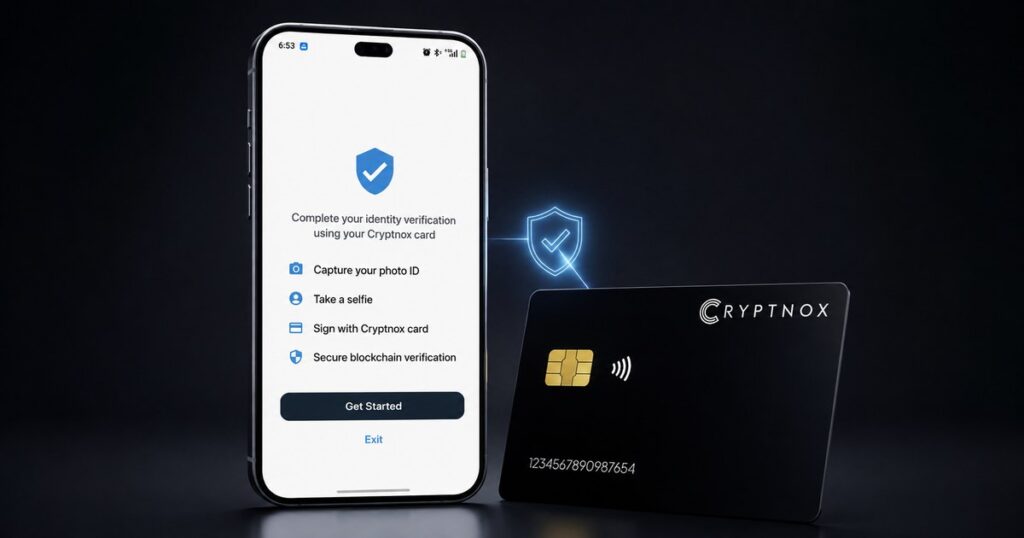
Identity verification normally proves information about a person. A cryptographic signature proves control of a key. Cryptnox Wallet combines these two elements by allowing an identity verification submission to be signed using a blockchain key held by a Cryptnox card.
The process can combine an identity document capture, optional ePassport NFC chip verification, face detection and active liveness checks, selection of a blockchain key, and a digital signature created with the Cryptnox card.
Identity Document → Biometric / Liveness Verification → Cryptnox Card & Private Key → Digital Signature Linked to a Blockchain Address
A passport or identity document provides information about a person. A cryptographic signature demonstrates that a party controlling a private key approved or signed specific data. These are two different kinds of proof, and most systems only ever use one of them.
| Identity verification | Cryptographic signature |
|---|---|
| Concerns information about a person | Demonstrates approval by a key holder |
| Can use documents and biometrics | Uses cryptographic keys |
| Establishes attributes | Establishes cryptographic proof |
Cryptnox combines these layers rather than treating them as the same thing. The identity checks establish who is submitting the verification; the signature establishes that a specific key, protected by a specific Cryptnox card, was used to approve it.
Exchanges and other crypto-asset service providers increasingly ask for exactly this combination before releasing funds to a self-hosted wallet. For the regulatory background, the five verification methods the EBA lists, and why a signed message is not the same thing as a Satoshi test, see What is a Satoshi test?
At a high level, the flow moves through these stages:
See the complete step-by-step Cryptnox Wallet identity verification tutorial →
Modern electronic passports can contain an NFC chip. Reading that chip can provide additional document-authenticity and data-verification evidence alongside the visual document capture.
A few things worth being clear about:
Reading the chip is one input among several. It is not, on its own, a claim that NFC verification guarantees a person’s identity.
There is a meaningful difference between detecting a face in a photograph, comparing two faces, and confirming that a real person is actively present during a verification session. Active liveness checks are built for the third case — typically through a simple prompt, such as turning the head, that would be difficult to reproduce from a static image.
A photograph can show a face. Active liveness is designed to add evidence that a real person is present during the verification process.
This is a factual description of what the check is designed to add, not a claim that any liveness method is spoof-proof.
Selecting Bitcoin, Ethereum, TRON or XRP in the Cryptnox Wallet identity flow does not send a cryptocurrency transaction. Instead, the selected key is used as the cryptographic identity of the signing operation.
The blockchain address identifies the public side of the key pair associated with the signature. Selecting the key does not transfer assets from that address.
The Cryptnox card participates in the signing operation and is the physical device used to protect the cryptographic key used for the signature.
The relevant private key remains protected by the card during the signing process, according to the product architecture. The signature that results from this process is tied to possession and use of that specific card and key, rather than to a password or credential that could be copied elsewhere.
Learn how the Cryptnox hardware wallet protects cryptographic keys.
The resulting verification can associate:
It is worth being precise here: this is not the same as writing a passport or personal data permanently onto a public blockchain. Using a blockchain key or address for a signature is a different action from publishing personal information on-chain, and Cryptnox’s identity verification flow does not do the latter.
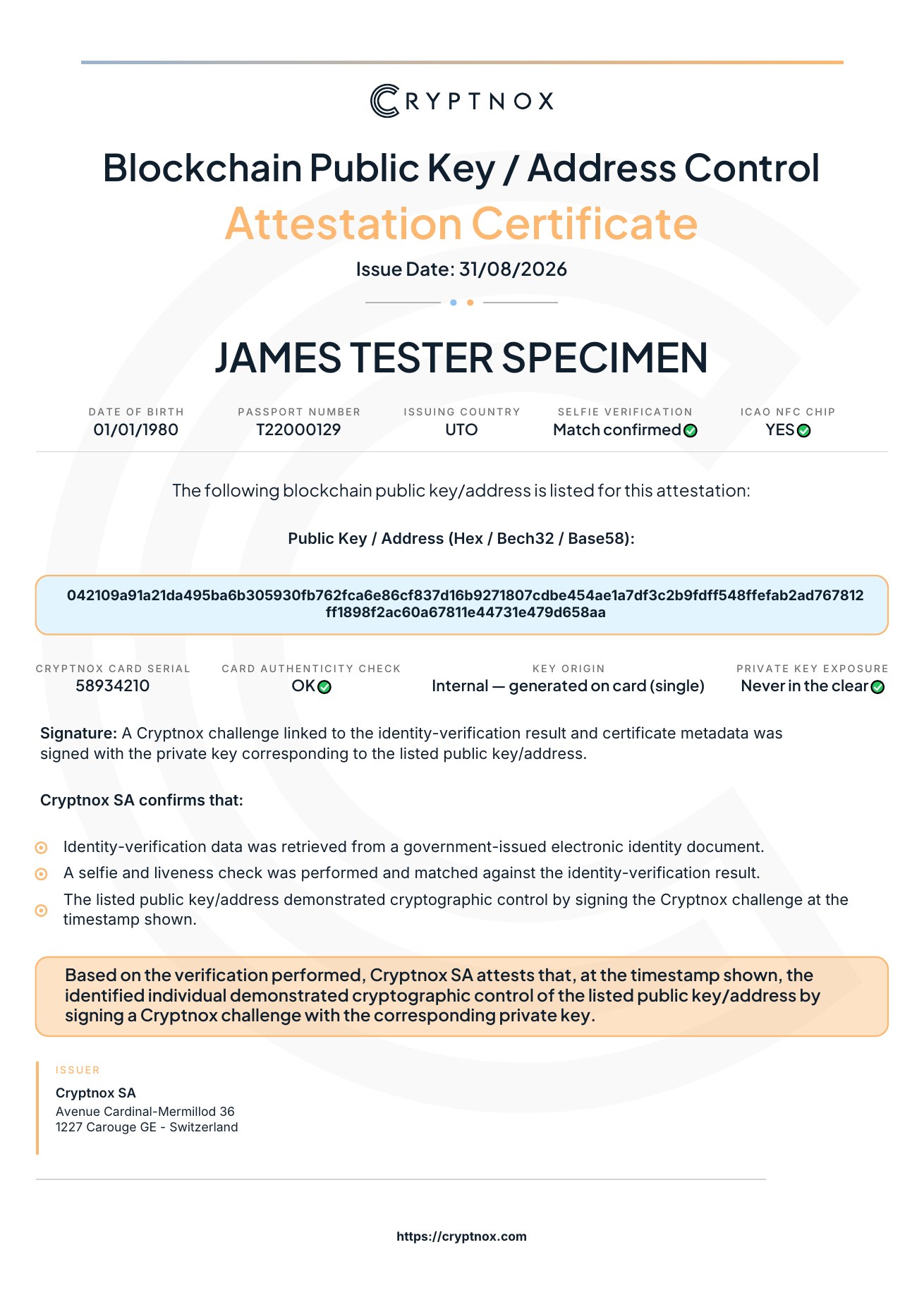
Conventional identity systems and blockchain systems have historically used different identifiers. Identity systems rely on names, documents and biometrics. Blockchain systems rely on public and private key pairs and addresses.
Cryptnox’s approach creates a mechanism for a verification process to be cryptographically associated with a key controlled through the Cryptnox card — a practical bridge between the two, grounded in what the product actually does, rather than a claim to have solved digital identity or built a universal decentralised identity system.
Blockchain-signed identity verification combines conventional identity checks with a cryptographic signature associated with a blockchain key. In Cryptnox Wallet, the identity verification flow can include document capture, optional ePassport NFC verification, biometric liveness checks and a signature created using a key protected by a Cryptnox card.
No. Selecting a blockchain key for identity verification does not create a cryptocurrency transfer. The key is used to produce a cryptographic signature associated with the verification.
Identity information and cryptographic key control are normally separate concepts. Cryptnox Wallet brings them together by combining identity-verification checks with a signature produced by a blockchain key protected by a physical Cryptnox card.
Want to understand the technology? Explore Cryptnox hardware wallet security.
Ready to complete your verification? Follow the full step-by-step identity verification tutorial.