
C-WaaS vs legacy issuer processors: where Marqeta, Paymentology and Episode Six sit
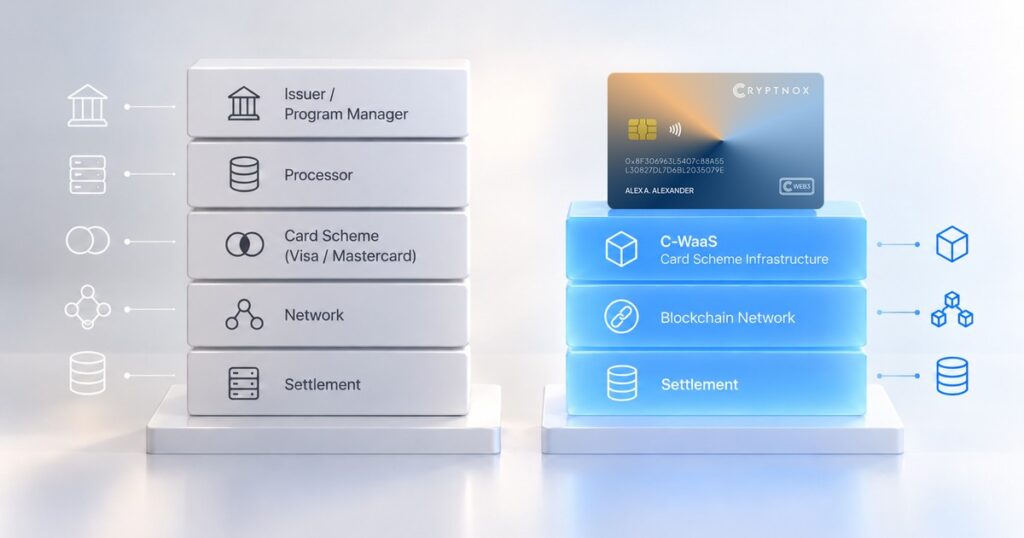
The first question a bank's card team asks about C-WaaS is usually "so is this like Marqeta?" It is a fair question, and the honest answer is that C-WaaS sits at a different layer of the stack. Issuer processors such as Episode Six, Paymentology, Marqeta, Thredd, i2c and Enfuce run cards inside the Visa and Mastercard schemes. C-WaaS is blockchain-native card scheme infrastructure: it replaces the scheme, the processor and the settlement layer with one stack that settles on a public chain. This article explains what an issuer processor does, where each piece of the legacy stack lives, what C-WaaS does differently, and why for many banks the right answer is both.
What an issuer processor does
An issuer processor is the technology company that runs a card programme on behalf of the issuer. When a cardholder taps or types a card number, the scheme network routes the authorisation request to the issuer's processor, which checks the account, applies the issuer's rules and answers in a fraction of a second. Around that core, processors provide card lifecycle management, APIs for the issuer's app, fraud tools, 3D Secure, tokenisation for mobile wallets, reporting, and often a ledger.
The companies banks shortlist today describe themselves like this, in their own words on their websites:
- Episode Six offers "next-gen ledger and card infrastructure for banks, fintechs and other innovators", covering prepaid, debit, credit, commercial and virtual cards with ledger management for accounts, revolving credit and instalments, across more than 45 markets.
- Paymentology calls itself "the ultimate global card issuer processor", with an issuing and processing platform that "helps banks & fintechs to launch innovative, secure, and flexible card payment products", and lists BIN sponsoring among its services.
- Marqeta positions itself as "enterprise-grade issuing and processing", handling "bank relationships, network approvals, and BIN sponsorship" alongside compliance and operations, with more than USD 400 billion processed over the four quarters to 30 June 2026.
- Thredd, formerly Global Processing Services, calls itself "the AI-first issuer processing platform", offering "end-to-end card issuing and processing" for prepaid, debit and credit cards in more than 50 countries, with BIN sponsor matching for its clients.
- i2c offers credit, debit and prepaid issuer processing on its "PowerOne unified banking and payments platform", with "25+ years" in banking and payments and "99.999% historical availability".
- Enfuce describes itself as a "cloud-native, modular issuer processor", born in the Nordics and serving banks and fintechs in Europe and beyond.
They are serious, mature companies, and nothing in this article suggests otherwise. What they have in common is the layer they occupy.
The legacy issuing stack
A card programme on a legacy card scheme is five layers deep.
- The issuer holds the licence, the BIN range and the cardholder relationship. A fintech without a licence rents these from a sponsor bank, which is what "BIN sponsorship" means.
- The issuer processor authorises transactions on the issuer's behalf and manages the cards. This is where Episode Six, Paymentology, Marqeta and the others live.
- The scheme network, Visa or Mastercard, routes every authorisation, clears every transaction, settles the money between banks on its timetable, sets interchange and scheme fees, writes the rules and runs the dispute process.
- The acquirer and its processor sign up merchants and certify their terminals.
- The merchant accepts the card.
The processor is essential, and it is also bounded. It does not own the network, it cannot settle outside the scheme, it does not set interchange, it cannot accept a card at a merchant the scheme has not reached, and its product lives within the scheme's rules, regions and certification cycles. None of that is a criticism of the processor. It is the shape of the four-party model.
Where C-WaaS sits
C-WaaS (Card Wallet as a Service) is blockchain-native card scheme infrastructure: a complete card issuing and payment processing infrastructure with direct on-chain settlement. Laid against the five layers above, it collapses three of them.
- Processing is the C-WaaS issuer backend. It authorises every payment against the operator's rules (limits, allowed assets, allowed recipients, screening, freezes), builds the on-chain transaction and returns the authorisation element the card needs to sign. In issuer-processor terms, this is the authorisation host, with one difference: the authorisation is cryptographically bound to the exact transaction and the card refuses to sign without it.
- The network and settlement are a public blockchain. There is no routing network to join, no clearing cycle and no scheme settlement bank. The signed transaction is broadcast and settles on chain, per payment, in the stablecoin or asset the operator chose.
- Acceptance is the C-WaaS point of sale application on standard payment terminals, with merchants registered directly with the scheme operator. There is no acquirer.
- The card is a secure-element card that holds the cardholder's key and signs each payment, rather than an EMV card carrying a static number that the processor authorises.
The issuer, meaning the scheme operator, keeps the top layer: brand, rules, licences, treasury and the cardholder and merchant relationships. Cryptnox provides the infrastructure underneath. That is the same split a processor offers its issuers, extended downward to cover the network and the settlement.
Read how the card scheme works or visit the C-WaaS page.
Side by side
| Dimension | Legacy issuer processor (Episode Six, Paymentology, Marqeta, Thredd, i2c, Enfuce) | C-WaaS |
|---|---|---|
| Layer | Processing layer inside a Visa or Mastercard programme | Processing, network and settlement in one stack |
| Network | Visa or Mastercard | Public blockchains (EVM chains, Solana, Tron, Bitcoin) |
| Settlement | Scheme clearing and settlement between banks, daily cycles | On chain, per transaction, in stablecoins or native assets |
| Who holds the money | The issuer's ledger (bank or e-money account) | The cardholder's on-chain account; the key stays in the card's secure element and neither the cardholder nor the issuer can move funds alone |
| Authorisation | Processor answers the scheme's request on the issuer's behalf | Issuer backend authorises the exact transaction; the card signs only with that authorisation |
| Card | EMV chip card with PAN, expiry and security code | EAL6+ certified secure element holding the cardholder's key; optional EMV application on the same card (dual-tech) |
| Acceptance | Every merchant in the scheme's network, worldwide | Merchants registered with the scheme operator, on C-WaaS terminals, kiosks, in-app and Web3; dual-tech adds scheme acceptance |
| Prerequisites | Issuer licence or BIN sponsor, scheme membership or sponsorship, scheme certification | Operator's own licences as its model requires; no scheme membership, no BIN, no scheme certification |
| Economics | Interchange and scheme fees set by the scheme; processor fees | Set by the operator; network fees can be sponsored; a different revenue and cost allocation |
| Disputes | Scheme chargeback process | Controls enforced before the card signs; dispute rules written by the operator |
| Card-not-present fraud | Exists; mitigated with 3D Secure, tokenisation, risk engines | Absent on the C-WaaS application: there is no static credential to steal (why); the EMV side of a dual-tech card keeps its card number |
| PCI DSS scope | Card data everywhere in the chain | No card data; the terminal holds no cardholder secret |
| Geography | Scheme regions and licences | Any market where the operator is licensed; the chain is global |
| Credit, instalments, rewards | Mature ledger products on most processors | Not a credit ledger; stablecoin and asset accounts |
| Integration | REST APIs, webhooks, hosted apps | REST APIs, white-label apps, POS applications, SDKs |
What legacy processors do better today
A fair comparison has to say this plainly. An issuer processor gives a bank, on day one, acceptance at every merchant that takes Visa or Mastercard, a dispute process cardholders know, credit and instalment ledgers, rewards engines, decades of scheme certification and the regulatory playbooks that come with them. Marqeta's processed volume and i2c's availability figures are the kind of track record a scheme operator built on C-WaaS does not yet have. C-WaaS does not offer a credit ledger, and acceptance on its own rails grows merchant by merchant from the operator's own branches and partners outward.
What C-WaaS offers in exchange is control of the layers a processor cannot touch: the network, the settlement and the rules, plus, on its own rails, the removal of the fraud category that lives on static card credentials.
Complementary, not either or
For most banks the realistic architecture is both, on one card. A dual-technology C-WaaS card carries an EMV payment application and a C-WaaS wallet application. The EMV side is processed by the bank's issuer processor exactly as today, so the card works at every scheme terminal and the processor's ledger, disputes and rewards continue to apply. The C-WaaS side is the bank's own blockchain-native scheme, settling on chain under the bank's rules. One card, one app, one cardholder relationship, two rails.
The C-WaaS backend is API-ready for EMV processors, so the two sides can share onboarding, card lifecycle events and a single cardholder app. The migration path is a slope rather than a switch: interchange keeps funding the programme while on-chain volume grows where the bank's own acceptance exists.
How to choose
- You need worldwide acceptance now, credit products and scheme economics. Use an issuer processor. That is what they are built for.
- You want your own rules, per-transaction on-chain settlement, a stablecoin product and no card-not-present fraud on your own rails. Use C-WaaS as your own card scheme.
- You want both, and a migration path rather than a bet. Issue dual-tech cards: your processor on the EMV side, C-WaaS on the scheme side.
Sources
Company descriptions are quoted from episodesix.com, paymentology.com, marqeta.com, thredd.ai, i2cinc.com and enfuce.com as read on 26 October 2026. Marqeta's processing volume is the figure it published with its second-quarter 2026 results (4 August 2026).
See C-WaaS or contact us.