
The stablecoin use case: what cross-border payments are losing to on-chain rails, and where a card fits
Sending money across a border still costs more than 6 percent on average and stops for nights, weekends and holidays. Stablecoins carried USD 135 billion of retail cross-border payments in 2025 and are growing seven times faster than fiat payments. What the data says, what the established players are doing about it, and how a card puts those rails in a customer's hand.
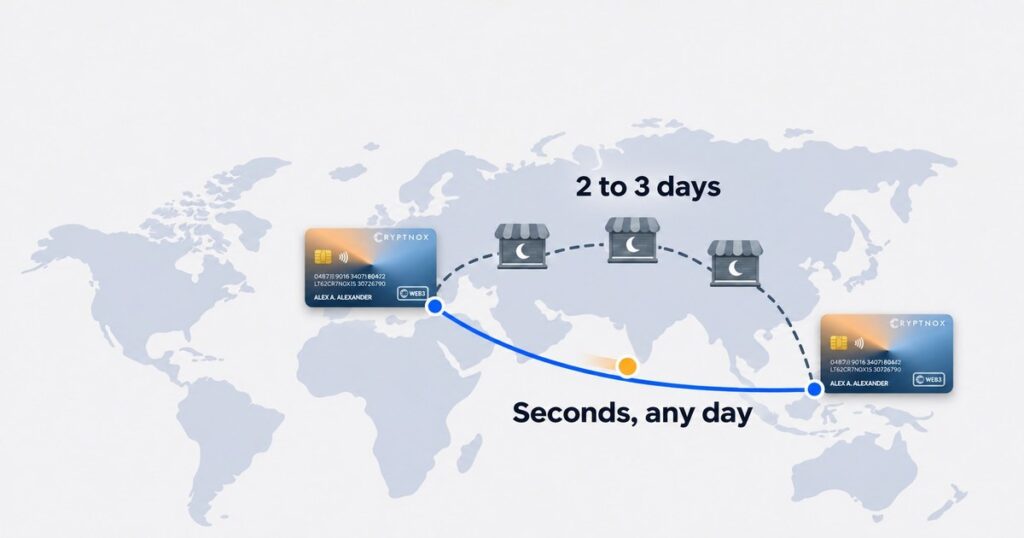
Sending money across a border is still slow and expensive. The World Bank's price survey put the average cost of sending USD 200 at 6.36 percent in the third quarter of 2025, against a United Nations target of 3 percent by 2030. Through a bank, the average was almost 15 percent. The money often arrives days later, because the systems that carry it close at night, at weekends and on public holidays that differ from one country to the next.
A stablecoin transfer does not wait for anyone's opening hours. On the faster chains it settles in seconds, at any time, for a network fee of cents. This post looks at how much business that is taking from the established cross-border players, what the data does and does not show, and how C-WaaS (Card Wallet as a Service), Cryptnox's blockchain-native card scheme infrastructure, puts those rails in a cardholder's hand.
Building a cross-border product? Ask for the architecture brief or a demo.
How big the shift is today
Small in share, large in speed.
- A July 2026 report by FXC Intelligence and Allium put stablecoins at about USD 135 billion of the USD 44.3 trillion retail cross-border payments market in 2025. That is 0.31 percent, up from 0.20 percent the year before.
- The same report measured stablecoin cross-border volume growing 64 percent year on year, against 9 percent for fiat payments. That is seven times faster.
- Allium's count of all stablecoin payments, domestic and cross-border, for the first eight months of 2026 is between USD 401 billion and USD 527 billion, up 42 to 63 percent on the year before.
- By use, the FXC Intelligence and Allium report puts stablecoins at 0.95 percent of person-to-person cross-border payments, and expects that share to pass 1 percent during 2026.
So the established players have not yet lost much volume. What they are losing is the growth.
What it looks like from inside the established players
The remittance leader. Western Union reported revenue of USD 1.0 billion for the third quarter of 2026, down 2 percent on the year before, with consumer money transfer revenue of USD 857 million, also down 2 percent. The pressure shows in the mix: its branded digital transactions grew 21 percent while the revenue from them grew 8 percent, so each digital transfer earns less than the one before. In 2026 it also launched its own dollar stablecoin, and it is building an always-on settlement layer on it between itself and its agents. When the market leader starts settling on a stablecoin, the argument about which rail is cheaper is largely over. What remains is the exchange-rate margin, and a transparent on-chain transfer makes that margin hard to defend.
The card schemes. The large international card schemes earn a cross-border fee and a currency conversion margin on every foreign transaction. They are not standing still either. UnionPay, for one, is linking its network to national instant-payment systems: in August 2026 it started a pilot that lets users of Chinese payment apps pay by QR code at merchants on Brazil's Pix. That is a different answer to the same problem: connect domestic systems to each other, rather than move value on a public chain. Other card networks and payment companies are building stablecoin settlement behind their existing products.
In short, everybody is repricing cross-border, and the benchmark they are repricing against is a stablecoin transfer.
Why time zones matter as much as cost
A cross-border bank payment passes through cut-off times in at least two countries. A payment sent on a Friday afternoon in Geneva to a supplier in Singapore reaches an account on Monday or Tuesday. For a business that is working capital tied up; for a family it is rent that arrives late. A public blockchain has no cut-off. That matters most to businesses, for which a weekend is an expensive thing to wait for.
Where the user's own wallet comes in
Much of this volume moves between wallets held by the users themselves, not accounts at an intermediary. That is the point of the rail: the sender's wallet pays the receiver's wallet, and no correspondent bank sits in between. It is also the rail's weakness. A wallet held on a phone is exposed to malware, a recovery phrase can be lost or stolen, a payment to a wrong address cannot be recalled, and nobody verifies who is on the other side.
For a consumer or a small business, that is the real barrier. The rail is ready. The wallet is not.
How C-WaaS helps
C-WaaS gives the stablecoin rail the thing a card scheme has always supplied: a trusted instrument at each end.
- A wallet that is a card. The key is held and used only inside the card's EAL6+ certified secure element. There is no recovery phrase and no key on the phone. A lost card is replaced with the same account.
- A check before every payment. The issuer backend checks limits, screening and approved destinations before the card signs. That answers the wrong-address problem, which a plain wallet leaves to the user.
- Identity at issuance. The card is issued to a customer the operator has identified, so the operator knows who controls each address in its scheme.
- Network fees handled. The operator can fund the fee, so the cardholder sends a stablecoin and never has to hold a second token to pay for it.
- Settlement that does not sleep. A payment from a card to an approved merchant or payee is broadcast at once and settles on chain at the chain's own speed, on a Saturday night as on a Tuesday morning.
- One card for both worlds. A Dual-Tech card also carries an EMV payment application for the shops that only take traditional cards.
For a bank or a fintech, that turns stablecoin cross-border payments from a wallet product for specialists into a card product for every customer. What the card earns for the bank is worked through in the business case for a bank, and the problems the scheme has to solve in the six problems a card on blockchain rails has to solve.
What this does not claim
- It does not claim that stablecoins have displaced the established players. At 0.31 percent of retail cross-border flows in 2025, they have not.
- It does not remove the conversion at either end. Someone still turns local currency into a stablecoin and back, and that step has a cost and a licence attached.
- It does not remove regulation. Transfers to and from user-held wallets fall under the transfer-of-funds rules where they apply.
- The figures above come from industry reports with different definitions. They are quoted for orientation, not as a forecast.
Sources
- World Bank, Remittance Prices Worldwide, Issue 54 (data for the third quarter of 2025): global average 6.36 percent for sending USD 200, banks 14.99 percent, digital services 4.59 percent.
- FXC Intelligence and Allium, "How big is stablecoins' share of the cross-border payments market? The state of adoption in numbers" (July 2026): USD 135 billion of USD 44.3 trillion in 2025, 0.31 percent against 0.20 percent in 2024; growth of 64 percent against 9 percent for fiat; 0.95 percent of person-to-person payments (read 17 November 2026).
- Allium, "State of Stablecoins and Payments: September 2026": USD 401 to 527 billion of stablecoin payments in the first eight months of 2026, up 42 to 63 percent (read 17 November 2026).
- Western Union, third-quarter 2026 results (4 November 2026), and FXC Intelligence, "Western Union reports strong digital growth in Q3 2026": revenue USD 1.0 billion, down 2 percent; consumer money transfer USD 857.2 million, down 2 percent; branded digital revenue up 8 percent on transactions up 21 percent; its dollar stablecoin and settlement layer (read 17 November 2026).
- UnionPay International, cross-border QR payment pilot on Brazil's Pix, announced August 2026, as reported by ECNS and Electronic Payments International (read 17 November 2026).
- Cryptnox, "C-WaaS: Blockchain-Native Card Scheme Infrastructure" (the scheme facts quoted above).
Facts as of 17 November 2026. Market figures come from the industry reports listed under Sources, which use different definitions, and are quoted for orientation, not as a forecast. Company names are used to identify the published results and announcements cited; no affiliation is implied. Regulatory qualification of a specific programme depends on the issuer's jurisdiction and setup and is confirmed with counsel.