
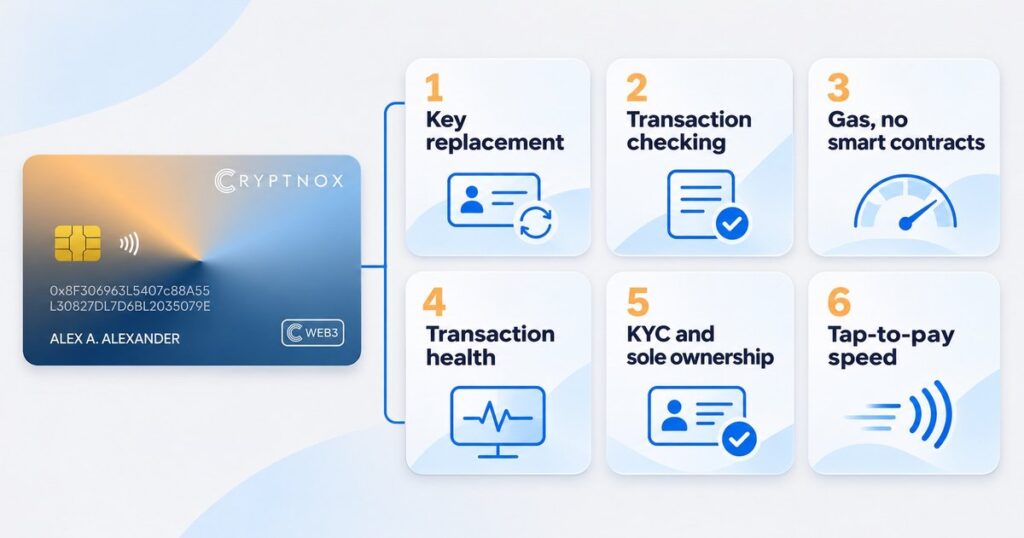
The six problems a card on blockchain rails has to solve, and how C-WaaS solves them
A lost card, a transaction that must be checked before it is signed and followed after it is broadcast, a fee token the cardholder does not hold, an address the bank must be able to vouch for, and a merchant who cannot wait for a chain. Six problems, and how a blockchain-native card scheme answers each.
A payment card that settles on a public blockchain sounds simple: put a key in a chip, tap, done. Anyone who has tried to run one knows the six places where it stops being simple. The cardholder loses the card. A transaction has to be checked before it is signed, and followed after it is broadcast. Every payment needs a native token for fees that the cardholder does not hold. The bank has to know who controls each address, and be able to prove it. And the merchant cannot wait for a chain to finalise while a queue forms.
C-WaaS (Card Wallet as a Service), Cryptnox's blockchain-native card scheme infrastructure, exists because each of those six problems has to be solved inside the scheme, not left to the cardholder. This post takes them one at a time: what the problem is, how software wallets and custodial providers deal with it today, and what the scheme does instead.
Want to see the six answers on a live card and terminal? Ask for a demo or the architecture brief.
1. Key replacement: a lost card must not mean lost funds
The problem. On a public blockchain the private key is the account. In a software wallet the key is backed up as a seed phrase, and the person who loses the phrase loses the funds: analysts cited by Ledger estimate that between 2.3 and 3.7 million bitcoin are permanently lost, most of them through lost or destroyed keys. Custodial providers avoid the problem by holding the key themselves, which is the model that puts every customer's funds in one pool behind one signer. A card programme cannot accept either answer. Cards are lost every day, and a bank cannot tell a customer that the balance went with the card.
What the scheme does. The cardholder's payment key is held and used only inside the card's EAL6+ certified secure element. It reaches the card through the patented issuance process (US 12,132,824 B2), in an envelope signed and encrypted for that one card, so no party in the logistics chain sees a secret, and it never leaves the chip afterwards. When a card is lost, the issuer freezes it and ships a replacement card carrying the same key. The cardholder keeps the same account, the same address and the same balances. There is no seed phrase to write down, no backup ceremony and nothing for support staff to recover. The management of a card's credentials after issuance is the subject of one of two international patent applications filed in 2026.
2. Transaction checking: the rules are applied before the signature exists
The problem. A software wallet signs whatever the user confirms, including a transfer to a scam address or a token the user did not mean to send. A custodial provider checks transactions, but it checks them in the same system that holds the keys, so a compromise of that system removes the check and the funds at once; the Binance incident of October 2026 is the latest example. A bank needs the controls it has on its existing cards (limits, blocked merchants, sanctions screening, instant freeze) on the blockchain card as well, and it needs them to hold even if its own backend is attacked.
What the scheme does. The issuer backend builds every transaction and parses it before anything is signed: chain, token, amount, recipient against the operator's allow-list of approved payout addresses and smart contracts, per-transaction and monthly limits, sanctions screening, and the freeze state of the card. Only then does it return an authorisation element that this one card can use for this one transaction. The card verifies the element and signs; without it the card refuses. Issuer-controlled co-signing is protected by US 12,719,697 B2. The check cannot be bypassed by the cardholder, and an attacker inside the issuer's backend can at most obtain authorisation elements, which move nothing without the card's own signature.
3. Gas without smart contracts: the cardholder never buys the fee token
The problem. Every public chain charges a network fee in its native token. A cardholder holding USDC on Ethereum cannot pay with it unless the same address also holds ETH, and the same is true of SOL on Solana or TRX on Tron. When the fee token runs out, the payment fails, and on Ethereum the gas for a failed transaction is still deducted. The industry's answer is account abstraction: ERC-4337 paymasters, which are smart contracts holding a deposit of the native token that pay the fee for a smart-contract account whose transactions are submitted through a bundler to an entry-point contract. It works, but it adds a contract wallet, a bundler and a paymaster deposit to every account, and the sponsorship is a priced service: one large provider adds 8% on top of the gas it covers on its pay-as-you-go plan.
What the scheme does. C-WaaS cards are plain accounts and settlement is a plain transfer. There is no contract wallet and no paymaster, because the issuer backend builds every transaction and knows exactly what fee it needs. The operator can sponsor fees so that a payment is simply a payment, or run gas as a managed allowance: the platform tops up each card's native-token balance on a formula the operator sets, typically as part of the cardholder's subscription. The cardholder never sees a gas fee and never needs to understand one.
4. Transaction health: every payment is followed to confirmation
The problem. Signing a transaction is not the end of it. A transaction can sit in the mempool because the fee it carries fell behind a spike, be dropped, or conflict with another transaction from the same account. A software-wallet user handles this by hand, with speed-up and cancel buttons. A card scheme cannot ask a cardholder or a merchant to do that, and it cannot leave a payment in an unknown state.
What the scheme does. Because the backend built and authorised the transaction, it knows the chain, the nonce, the fee and the expected confirmation time, and it tracks the transaction from broadcast to confirmation. The merchant's terminal shows "Approved" with the on-chain reference, the cardholder's app shows the transaction and its state, and the operator's reporting shows every payment it authorised against what the chain confirmed. A transaction that stalls or fails is handled by the platform, not by the cardholder.
5. KYC and proof of sole ownership: the bank knows who controls each address
The problem. A bank that lets customers move stablecoins to a self-hosted wallet has to establish who controls that wallet. In the EU, Regulation (EU) 2023/1113 on information accompanying transfers of crypto-assets, applicable since 30 December 2024, requires the crypto-asset service provider to verify that its own customer owns or controls a self-hosted address for transfers above EUR 1,000, with guidance on the means of verification left to the European Banking Authority. In practice that means signed-message challenges and manual checks, repeated per address. A seed phrase makes the question worse: a phrase can be copied, so even a verified wallet may be controlled by several people.
What the scheme does. A C-WaaS card is issued to a customer the bank has identified, and the key for that card's address exists in exactly one secure element, held by that customer. It cannot be exported, copied or written down. The issuer therefore knows who controls every address in its scheme at the moment of issuance and for as long as the card is in use, and it can state so without a signed-message ceremony, because sole control of the key is a property of the card, not a declaration by the customer. The issuer still enforces its own screening on every transaction, and classification of a specific programme under EU or Swiss frameworks depends on who holds recovery and administrative powers in aggregate; Cryptnox designs for the favourable case and the operator confirms with counsel.
6. Fast tap-to-pay at the point of sale
The problem. Chains confirm on their own schedule. Ethereum produces a block every twelve seconds and finalises after two epochs of thirty-two slots, about thirteen minutes; Bitcoin averages ten minutes per block; Solana and Tron confirm in seconds. None of those schedules is a checkout. A merchant needs a yes or a no in the time it takes to tap a card, and the yes must mean the payment will settle.
What the scheme does. The merchant enters the amount and the cardholder taps. The terminal relays between the card and the issuer backend; it holds only its own identity in a Secure Access Module and cannot sign or redirect a payment. The backend builds the transaction, applies the operator's rules and authorises it; the card verifies the authorisation and signs. Below the threshold the operator sets, the payment is broadcast at once and the terminal shows "Approved" with the on-chain reference: in Cryptnox's development environment a tap is approved in one to three seconds depending on the terminal. Above the threshold the cardholder adds a second factor, in the app or with a POS passcode on the terminal, exactly as contactless limits work today. Final settlement then follows the chain, from well under a second on Solana to several minutes on Ethereum mainnet. Tap-to-pay authorisation at merchant terminals is the subject of the second international patent application filed in 2026.
The six problems, side by side
| Problem | Software wallet | Custodial provider | C-WaaS |
|---|---|---|---|
| Lost key or card | Seed phrase, or the funds are gone | Provider holds the key for everyone | Issuer freezes the card and ships a replacement with the same key |
| Checking a transaction | The user confirms whatever is shown | Checked inside the system that also holds the keys | Checked by the issuer backend before the card will sign; neither side can act alone |
| Network fees | The user buys and holds the fee token | Absorbed by the provider inside its pool | Sponsored or topped up by the operator on a formula; no smart contract, no paymaster |
| Following the payment | Speed-up and cancel buttons | Internal ledger entry, chain later | Tracked by the backend from broadcast to confirmation, reported to merchant, cardholder and operator |
| Who controls the address | Unknown to anyone but the user, and copyable | The provider, for all customers at once | An identified cardholder, with a key that exists in one chip only |
| Speed at the counter | Chain time | Instant, off chain, on the provider's books | Authorised and broadcast at the tap; one to three seconds in Cryptnox's development environment |
What this means for an issuer
The six problems are the reason most "crypto cards" on the market are custodial: it is the easiest way to make all six disappear from the cardholder's screen, at the price of a pooled hot wallet and a provider that signs on everyone's behalf. C-WaaS takes the other route. The cardholder keeps the key, the issuer keeps the rules, and the infrastructure takes on replacement, checking, fees, tracking, identity and speed as scheme functions, which is what they are on any card scheme that has worked at scale. The economics that follow from that, including what a bank can charge for it, are covered in how a bank earns from a blockchain card scheme, and what it gives a young bank in the neobank article.
Sources
- Ledger Academy, "How many Bitcoin are lost?", citing Chainalysis: between 2.3 and 3.7 million bitcoin estimated permanently lost as of early 2025 (read 2 November 2026).
- Etherscan Knowledge Base, "What are the reasons for failed transactions?": the gas fee is deducted on a failed transaction; "Out of Gas" when the gas limit is below the required gas (read 2 November 2026).
- Alchemy, "What is a paymaster?": an ERC-4337 contract with a deposit of native gas token on the EntryPoint; pay-as-you-go adds 8% on top of the mainnet gas covered (read 2 November 2026).
- Regulation (EU) 2023/1113 on information accompanying transfers of funds and certain crypto-assets, applicable from 30 December 2024; EUR 1,000 threshold for ownership or control verification of self-hosted addresses, EBA guidance on the means of verification.
- ethereum.org, "Proof-of-stake": slots of 12 seconds, epochs of 32 slots, finality by checkpoint between epochs (read 2 November 2026).
- Cryptnox, "C-WaaS: Blockchain-Native Card Scheme Infrastructure" and "How a blockchain-native card scheme works" (the scheme facts quoted above).
Facts as of 2 November 2026. Timings refer to Cryptnox's development environment and depend on the terminal. Certification statements refer to the NXP secure element and JCOP platform in their evaluated configurations, not to the finished card. Regulatory qualification of a specific programme depends on the issuer's jurisdiction and setup.