
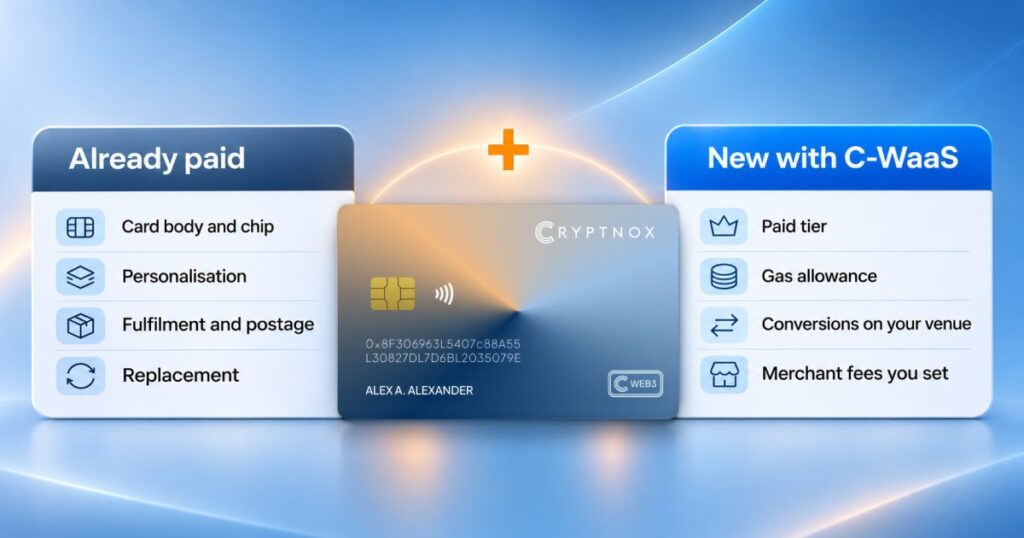
The C-WaaS business case for a bank: the card is already paid for, the revenue is new
A bank pays to issue a physical card whether or not the chip carries a second application. Adding C-WaaS to that card costs little and opens revenue the card never had: a paid tier, network fees as a managed allowance, conversions on the bank's own venue, and merchant economics the bank sets itself.
Every bank that issues cards already carries the cost of issuing them: the card body, the chip, personalisation, fulfilment, the envelope, the replacement when one is lost. That cost does not change when the card also carries a blockchain-native application. What changes is the revenue side. A card that is a cost centre earning a capped interchange becomes the anchor of a paid tier, a managed network-fee allowance, a conversion flow that runs on the bank's own venue, and a merchant relationship the bank prices itself.
This post works through the economics of C-WaaS (Card Wallet as a Service), Cryptnox's blockchain-native card scheme infrastructure, from a bank's side of the table. It is the companion to the six problems a card on blockchain rails has to solve, which covers what the scheme does; this one covers what it earns.
Want the numbers for your own card base? Ask for the architecture brief or a demo.
The card is a cost you already carry
A physical card programme pays for design, production and dispatch of a security-compliant card, tokenisation into digital wallets, processing, and the staff and fraud costs around it. The per-card figures are rarely published, but the public price lists give the order of magnitude. A card-issuing platform lists its standard plastic card at USD 3.50 in the United States, GBP 3.50 in the United Kingdom and EUR 3.50 in the European Union, with shipping charged on top, and its custom-designed cards at a minimum order of 2,500 and eight to ten weeks of lead time. A card manufacturer's guide puts metal constructions at roughly USD 10 to 15 for a metal inlay, about USD 15 for a metal veneer and above USD 25 for a full metal card. Then come the costs no price list shows: the envelope and postage, the activation flow, and the replacement card every time one is lost or expires.
Every one of those costs is incurred whether or not the chip carries a second application. A Dual-Tech C-WaaS card is a card with an EMV payment application for your Mastercard or Visa product and the C-WaaS wallet application on the same EAL6+ certified secure element; a Triple-Tech card adds a FIDO2 security key. The blockchain application is software on a chip that the card needs anyway. Measured against the issuance cost the bank pays in any case, the marginal technology cost of adding C-WaaS to the card is small. The question is therefore not what the card costs. It is what the card can earn once it carries a key.
What a card earns today, and why that is the problem
The Federal Reserve's own research on US credit cards, based on supervisory data from 2014 to 2021, found that around 80 percent of card profits come from interest income, around 15 percent from usage fees such as late and foreign-exchange fees, and that net interchange revenue, after rewards, is slightly negative. In Europe, Regulation (EU) 2015/751 caps consumer interchange at 0.2 percent for debit and 0.3 percent for credit; a card-issuing platform's guide describes consumer interchange as "around 20-30 bps or lower" and notes that the more parties sit in the chain, the smaller the issuer's share. A debit card in Europe is, in revenue terms, close to a cost centre with a brand on it.
The banks that have grown fastest have answered this with subscriptions. Revolut's annual report for 2025, released on 24 March 2026, reports subscription turnover of USD 936 million (GBP 708 million), up 67 percent on the year, with paid-plan adoption up 42 percent, next to USD 1.3 billion of card-payment revenue on 68.3 million retail customers. The paid tier is where a premium card lives, and the premium card is what makes the tier feel worth paying for. That is the model a blockchain card scheme plugs into.
Revenue line 1: the paid tier
A C-WaaS card gives a bank something no plastic upgrade gives: a card in which the customer's own key sits, with a replacement that carries the same account if the card is lost, payments that settle on a public chain, access to Web3 through WalletConnect and MetaMask from the bank's own app, and a payment path on which the card-not-present fraud category does not exist. Those are features a customer can see and compare, which is what a tier needs.
The cost side of the tier is per card, not per customer: the issuance cost the bank already pays, plus the scheme's operating costs. The revenue side is a monthly or annual fee the bank sets, in the range it already uses for its premium plans. The crypto-native precedent exists: Coinbase describes its Coinbase One subscription, now in three tiers, as serving two purposes, "generating recurring subscription revenue and deepening user engagement" across its products, including trading revenue and card interchange. A bank with the account relationship, the card and the app is better placed to run that model than an exchange is, because the customer is already there.
Revenue line 2: gas as a managed allowance
Every payment on a public chain carries a network fee in that chain's native token. The fee is small and it is the cardholder's problem on every self-managed wallet; a survey of transfer costs published in April 2026 puts a stablecoin transfer at USD 0.0001 to 0.0005 on Solana, USD 0.005 to 0.20 on Arbitrum, USD 0.20 to 2.00 on Ethereum mainnet with spikes above USD 10, and USD 1.44 to 2.89 on Tron with rented energy. The industry has already turned fee sponsorship into a priced service: account-abstraction providers run paymaster contracts that cover gas for smart-contract accounts, and one large provider adds 8 percent on top of the gas it covers on its pay-as-you-go plan.
On C-WaaS the operator can sponsor network fees so that a payment is simply a payment, or run gas as a managed allowance: the platform tops up each card's native-token balance on a formula the operator sets, as part of the subscription or at a margin on each top-up. Because cards are plain accounts and the issuer backend builds every transaction, this needs no contract wallet and no paymaster; the backend knows what fee each payment needs and funds it. The bank buys the fee token at scale, the cardholder never sees a gas fee, and the difference between the two is a revenue line the card never had.
Revenue line 3: the conversion happens in your app, on your venue
A cardholder who funds a stablecoin card converts fiat into stablecoin to do it, and converts back when the balance comes home. On a white-label programme that conversion happens on the provider's venue, and the spread goes to the provider. On C-WaaS the cardholder app carries the bank's brand, and the buy, sell and funding flows can route to the bank's own exchange or brokerage, or to the venue it chooses.
The value of that routing is visible in the public filings of the largest retail venue. Coinbase's annual report for 2025 shows consumer transaction revenue of USD 3.32 billion on consumer trading volume of USD 239 billion, which works out at about 1.4 percent of volume (our calculation from the reported figures; Coinbase attributes the year's decline in its blended fee rate to customers moving to lower-fee advanced and subscription tiers). A bank that already holds the customer's fiat account, identity and card does not need to send that conversion to a third party. It can price it as it prices foreign exchange today.
Revenue lines a scheme member never had
The three lines above exist because the bank owns the customer relationship. The next set exists because, on C-WaaS, the bank also owns the scheme. On a legacy card the scheme sets the rules and the economics; on a blockchain-native card scheme the operator does, and there is no interchange, no scheme fee and no BIN sponsorship on the C-WaaS side. That opens lines that a scheme member cannot touch today:
- Merchant acceptance, priced by you. Merchants register directly with the scheme operator, enrol their terminals and are paid to their own wallet per transaction, with no acquirer in between. The acceptance fee, the onboarding fee and the terms of the point-of-sale application are the operator's to set.
- Funding and withdrawal spread. The conversion between the customer's fiat balance and the settlement stablecoin is a foreign-exchange style spread the bank keeps, on the way in and on the way out.
- Your own settlement asset. The operator chooses the stablecoin or asset its cards settle in. A bank that issues its own tokenised deposit or stablecoin can make it the scheme's settlement asset, so that the balances cardholders hold are balances the bank has issued.
- Curated on-chain products. The policy engine's allow-list of smart contracts lets the operator decide which on-chain products its cardholders can reach from the app, and take a commission on the ones it curates.
- Commercial cards on the same rails. Corporate expense cards, payroll and supplier payments in stablecoin run on the same scheme, with the same controls, for business customers who pay per card and per seat.
- The card that is also the login. A Triple-Tech card is a FIDO2 security key: the card that pays is the card that signs the customer into online banking, which replaces one-time codes sent by SMS and paid for per message, and is a security feature a bank can charge for.
- Costs that become margin. On the C-WaaS side there is no card-not-present fraud category, no chargeback after settlement and no scheme fee, and a lost card is replaced with the same account rather than reimbursed. Each of those is a line in today's card P&L that the blockchain card does not carry.
| Revenue line | Who pays | When | Set by |
|---|---|---|---|
| Paid tier | The cardholder | Monthly or yearly | The bank, in line with its premium plans |
| Gas allowance or top-up margin | The cardholder, inside the tier or per top-up | Per payment, funded on a formula | The bank |
| Conversion on your own venue | The cardholder, as a spread | On funding and withdrawal | The bank |
| Merchant acceptance | The merchant | Per transaction, plus onboarding | The scheme operator |
| Settlement in your own asset | Reserve income stays with the issuer of the asset | Continuous | The bank, if it issues the asset |
| Curated on-chain products | The product provider or the cardholder | Per use | The scheme operator |
| Commercial cards | The business customer | Per card and per seat | The bank |
| FIDO2 login on the card | The bank's own cost base, then the customer as a feature | Per login replaced | The bank |
What the bank does not take on
A blockchain-native card scheme is not a custody business. The cardholder's key stays in the card's secure element and the issuer holds a separate authorisation key; a payment needs both, so the issuer can approve but cannot spend, and there is no pooled hot wallet on the bank's books for an attacker to drain. Cryptnox positions this as qualifying for self-custody treatment under EU and Swiss frameworks; classification of a specific programme depends on who holds recovery and administrative powers in aggregate, which the operator confirms with counsel. The bank keeps its compliance controls and its licences, and it does not become the custodian of its customers' crypto-assets in order to earn from them.
Sources
- Stripe, "Physical cards" (Issuing documentation): standard cards USD 3.50 in the US, GBP 3.50 in the UK, EUR 3.50 in the EU, shipping charged per region; custom cards minimum 2,500, 8–10 weeks (read 2 November 2026).
- ABCorp, "Metal card manufacturing: what payment card programs need to know": metal inlay about USD 10–15, metal veneer about USD 15, full metal above USD 25 per card (read 2 November 2026).
- Marqeta, "Demystifying cards: costs of a card program": consumer interchange "around 20-30 bps or lower", business "more like 150 bps"; "the more parties in the ecosystem, the lower your share of interchange will be" (read 2 November 2026).
- ABA Banking Journal, 24 October 2022, on the Federal Reserve note "Credit card profitability": around 80 percent of profits from interest income, around 15 percent from usage fees, net interchange slightly negative (FR Y-14M data, 2014–2021).
- Regulation (EU) 2015/751 on interchange fees for card-based payment transactions: caps of 0.2 percent (debit) and 0.3 percent (credit) for consumer cards.
- Revolut, "Revolut reports record profit of $2.3bn for 2025 as revenue surges to $6bn", 24 March 2026: subscriptions turnover USD 936m (GBP 708m), +67 percent; paid-plan adoption +42 percent; card payments USD 1.3bn; 68.3m retail customers.
- Coinbase Global, Inc., Form 10-K for the year ended 31 December 2025: consumer transaction revenue USD 3,322.8 million; consumer trading volume USD 239 billion; blended fee rate explanation; Coinbase One description.
- Plisio, "USDT transfer fee in 2026", figures pulled mid-April 2026, and Alchemy, "What is a paymaster?": pay-as-you-go adds 8 percent on top of the mainnet gas covered (both read 2 November 2026).
- Cryptnox, "C-WaaS: Blockchain-Native Card Scheme Infrastructure", "How a blockchain-native card scheme works" and "Why card-not-present fraud cannot exist on a C-WaaS card scheme" (the scheme facts quoted above).
Figures as read on 2 November 2026 from the public sources listed above; third-party prices and results are those companies' own statements and are quoted for orientation, not as a forecast of any programme's economics. Regulatory qualification of a specific programme depends on the issuer's jurisdiction and setup.