
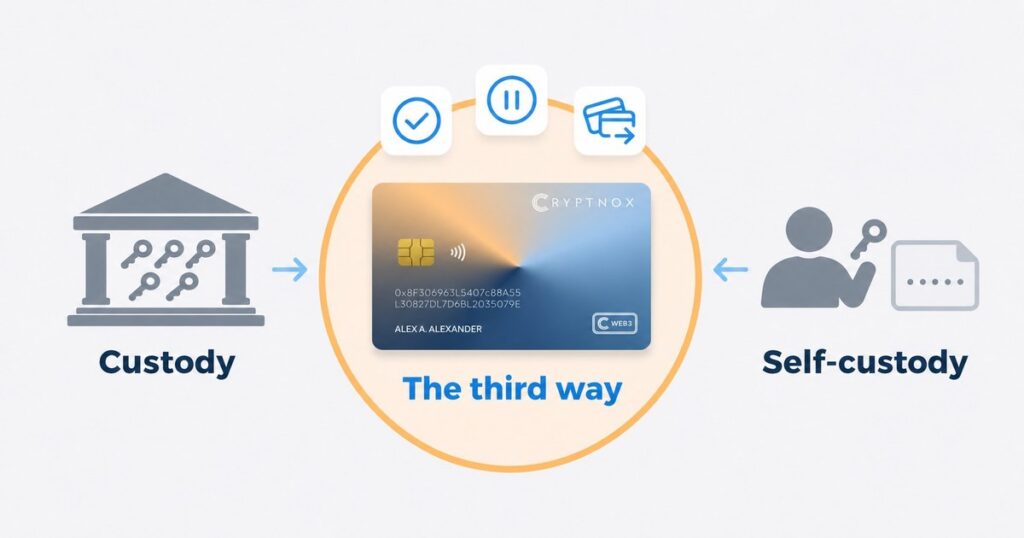
Custody or self-custody? The third way is a card
With custody a provider holds the key and signs for you; with self-custody you do. That decides who can lose your assets, and also what they are allowed to do. The two models compared on both counts, with figures and with their limits, and a third model in which the key stays in the customer's card while a bank or an issuer provides the service around it.
With custody, a provider holds the private key to your digital assets and signs for you. With self-custody, you hold the key and sign yourself. The choice is usually told as a question of safety: who is more likely to lose your assets, a company or you?
That is half of the answer. Whoever controls the signature also decides what your assets are allowed to do. In custody they can do what the provider supports. At an address you control they can do what the blockchain allows: hold the tokens issued there, use exchange contracts directly, move at any hour.
This post compares the two models on both counts, with figures and with their limits. It then describes a third model, assisted self-custody, as C-WaaS (Card Wallet as a Service), Cryptnox's blockchain-native card scheme infrastructure, is designed to deliver it: the key in the customer's own card, and a bank or an issuer providing the service around it. C-WaaS is almost ready for production.
Running a card programme? Ask for the architecture brief or a demo.
Custody vs self-custody at a glance
Custody, or a custodial wallet. A provider controls the keys on your behalf. You see a balance and log in; the provider signs. The assets behind customers' balances are often held together in a few large wallets.
Self-custody, or a non-custodial wallet. You control the key yourself, in a hardware wallet, in an app or on paper, and your assets sit at an address that no service provider manages. EU rules call it a self-hosted address. No provider can sign for you, and none can restore your access if you lose the key and its backup. This post means that plain form, one key and one backup, when it says self-custody; wallets with several signers or built-in recovery exist, and they shift some of the trade-offs below.
Four questions tell you which model a product really is, whatever its label:
- Who can sign a payment?
- Who can block one?
- Who can restore access when something is lost?
- What happens to the assets if the provider disappears?
The rest of this post answers them for each model.
What the record shows
Both models fail, in different ways.
At a custodian, one breach can be very large. Chainalysis counted more than USD 3.4 billion in digital assets stolen across the whole industry between January and early December 2025. A single breach at a single exchange, in February, accounts for about USD 1.5 billion of it: one compromised signing process, one wallet. Whether customers bear such a loss depends on the law, the contract and the provider's ability to pay. We walked through a more recent case in the analysis of the October exchange hack.
A provider can also fail from the inside. When a large exchange went bankrupt in November 2022 after misusing its customers' assets, those customers became claimants in the bankruptcy, and the first distributions started in February 2025, more than two years later. At an exchange that failed in 2014, repayments in bitcoin began in July 2024.
Personal wallets are hit often, for smaller amounts each. The same study estimates 158,000 compromises of personal wallets in 2025, with at least 80,000 victims, for USD 713 million. That is far more incidents, for about a fifth of the reported total.
Then there is plain loss. A wallet whose key and backup are both gone cannot be opened by anyone. Published estimates of the bitcoin lost this way run into millions of coins, although they infer loss from long inactivity and cannot be exact.
These figures show how each model can fail. They do not measure which is safer for a given person: that depends on the provider chosen in one case, and on the person's own care in the other.
Custodial wallets: what you gain and what you risk
Providers differ. The pattern is this.
| You gain | You risk |
|---|---|
| The provider can restore your access if you forget a password | A breach or an insider can hit many customers at once |
| The provider screens transactions and runs a support desk | The provider can freeze or delay withdrawals, or fail |
| Little to learn: it works like online banking | Your rights if it fails depend on how it holds the assets, and under which law |
| Buying and selling against ordinary money is built in | You can hold and do only what the provider supports |
| The provider usually supplies statements for your tax return | The provider sees and records what you do, and reports what the law requires |
The third line deserves a word. Regulated custody that keeps client assets legally segregated, as the EU's MiCA regulation requires of authorised custodians, protects the client's ownership if the custodian fails. A balance held on a trading platform under looser terms may be no more than a claim on the company. The difference is in the contract and the jurisdiction.
Self-custody wallets: what you gain and what you risk
| You gain | You risk |
|---|---|
| No provider can move your assets, or withhold them by refusing to sign | Lose the key and its backup, and the assets are out of reach for good |
| Your assets do not sit behind someone else's signing system | A settled transfer cannot be recalled, and you alone approve it, whatever warnings your wallet shows |
| No dependence on a provider staying solvent | The backup is yours to manage: a recovery phrase, or a second device |
| The chain is open to you: its tokens, its contracts, at any hour | Signing a malicious contract, or a request from a fake site, can drain what it covers |
| No provider stands inside your transfers | A phone or computer that holds the key is exposed to malware |
Two limits apply even here. The issuer of a token can keep powers over it: the large stablecoins, for instance, can be frozen at a given address by their issuer. And self-custody removes the custodian, not every dependency: the wallet software and the chain itself still have to work.
Put side by side, the two lists mirror each other. Custody is comfortable, and it concentrates both the risk and the decisions in one provider. Self-custody removes that concentration and hands the operational burden to the user.
The other half: what your assets can do on chain
Most comparisons stop at safety. For anyone who uses digital assets and does not just hold them, the daily difference is freedom of action. Three things change when you control the address.
1. You are not limited to a provider's list. A custodian supports the assets it has chosen to list, on the networks it has chosen to connect. A new stablecoin, a token the custodian has not reviewed: until it is listed you cannot hold it there, and a deposit sent over a network the custodian does not support can be stuck or lost. An address you control does not wait for anyone's listing decision: as a rule it can receive a token issued on its chain as soon as the token exists. The exceptions come from the token or the network itself, for instance a tokenised security whose rules restrict who may hold it.
2. Exchange contracts are open to you. In a custodial account you use the trading venue and the on-chain services the provider has decided to offer, on its terms. A wallet you control connects directly to the exchange contracts that run on the chain: you swap one asset for another against a public pool, without opening an account and without first handing your assets to a company. Lending contracts are reached the same way, with one difference worth knowing: there, your assets move into the contract, and getting them back depends on its code and its liquidity.
3. A direct transfer has no intermediary in it. Identity checks and transfer-information rules attach to service providers. In the EU, the Transfer of Funds Regulation requires crypto-asset service providers to obtain and keep sender and recipient information for the transfers they carry out. When such a transfer exceeds EUR 1,000 and goes to or comes from a self-hosted address, the provider must in addition assess whether its customer owns or controls that address. Since 1 January 2026, providers in scope of the DAC8 directive also collect data on their customers' transactions for annual reporting to the tax authorities, including the yearly totals those customers send to addresses the provider does not know to belong to another provider. For the transfer rules, what decides is whether a service provider takes part: a person-to-person transfer carried out without one is outside the Transfer of Funds Regulation, which says so in its Article 2(4). When you move funds between two wallets of your own without using a service provider, there is no provider to run a check on that transfer or to attach information to it.
That is a statement about the scope of those rules, not an exemption from the law. Tax, record-keeping and sanctions obligations apply to you directly. A bank or an exchange may ask where funds came from when they arrive. The transfers themselves stay visible on a public ledger. And standard-setters keep the area under watch: the FATF's July 2026 update lists self-hosted wallets among the risks it asks countries to address. None of this is a statement about C-WaaS: there, the operator authorises every payment, and what that means for a programme's duties is addressed in the limits below.
| Item | Custodial account | Address you control |
|---|---|---|
| Assets you can hold | Those the provider lists | The tokens issued on the chain, subject to each token's own rules |
| Swapping one asset for another | On the venue the provider offers | Directly against exchange contracts |
| Lending and other on-chain services | Those the provider has connected | Any contract open to you, at your own risk |
| Moving funds | A withdrawal request, within the provider's limits, fees and checks | A transfer at any hour, for the network fee |
| Who stands inside a transfer | The provider, with its checks, records and reports | No provider, in a direct transfer |
| Who vets what you sign | The provider | You, with whatever warnings your wallet gives |
The last row is the price of the other five. Every freedom in the right-hand column arrives without a custodian's filter, and the personal-wallet figures above give an idea of what is at stake.
The same choice, seen from the institution
A bank, a neobank or a fintech that wants to offer digital assets faces the same two models from the other side of the counter.
| Item | Custodial product | Plain self-custody app |
|---|---|---|
| What the institution controls | Its customers' keys | No keys |
| What it takes on | Safekeeping duties, itself or through a custodian it appoints, the consequences of a breach that can hit many customers and, depending on its status, an authorisation or notification covering custody | No safekeeping. Its other duties depend on the services it adds, such as exchange or transfers |
| What it can do for the customer | Restore access, screen payments, correct its own errors | Little: it cannot restore a lost key or stop a mistaken payment |
| What it can offer on chain | What it lists, connects and has safekept | Whatever the chain offers, with no say over it |
| What the customer experiences | Online banking | Backups, network fees and long addresses |
The custodial product is familiar to sell and heavy to carry. The self-custody app is light to carry, hard to sell to ordinary customers, and leaves the institution unable to help when something goes wrong. Neither is a comfortable place for a regulated brand.
The third way: the key in the card, the service around it
Custody bundles two roles: holding the key, and deciding whether it signs. C-WaaS separates them.
The key is in the cardholder's card. It reaches the card through a patented issuance process in which no party sees it, and it is held and used only inside the card's EAL6+ certified secure element. There is no pooled wallet: each cardholder's assets sit at the card's own address on a public chain.
The operator provides the service. The bank or issuer that runs the scheme builds each transaction and checks it before anything is signed: limits, sanctions screening, and its allow-list of approved destinations and contracts. Then it signs an authorisation. That signature moves nothing. The card signs the payment itself, once it holds a valid authorisation and the cardholder's factor is satisfied: a tap at a terminal for small amounts, a second factor above a threshold the operator sets. A payment needs both sides: an authorisation cannot pay without the card, and the card cannot pay without an authorisation.
We call this "assisted" self-custody, and the word "assisted" carries weight. This is not a wallet that signs and broadcasts on its holder's word alone. It is a design in which the key is used only inside the customer's card, and the provider's role is limited to authorising or refusing a payment, freezing a lost card and replacing it. The term describes the design. It is not a legal classification, which depends on each programme and is dealt with in the limits below.
Against the four questions:
- Who can sign? Only the card. It signs when it is presented, holds a valid authorisation and, above the operator's threshold, has the cardholder's second factor.
- Who can block? The operator, by refusing an authorisation or freezing the card. The cardholder, by not presenting the card.
- Who can restore access? The operator. It freezes a lost card and issues a replacement that carries the same key through the same issuance process, so the account, the address and the balance are unchanged. There is no recovery phrase. Who may order a replacement, and under which checks, is a control every programme has to define.
- What if the provider disappears? The assets stay at the card's address, but the card cannot pay without an authorisation: an operator that is offline, or that stops its service, stops the card. That dependence is the price of the assistance, and what a programme provides for that case is the first question to put to it. A breach is a different matter: a stolen authorisation cannot sign a payment, since only a card does. Card replacement is the other power an operator holds, which is why its controls matter as much.
On-chain access, through the operator's door. Each account is its own address on a public chain, and the card is not limited to payments. It can sign any kind of transaction on the chains it supports: a transfer, a swap on an exchange contract, a deposit, any other contract call. C-WaaS sets no technical limit there. The operator's policy sets the limit. At a payment terminal the scheme signs plain transfers to approved destinations. In the app, a programme can connect the cardholder to on-chain applications through WalletConnect and admit as many contracts as it chooses, exchange contracts included.
So how much of the freedom described above reaches the cardholder is the operator's choice, not a limit of the technology. One bank may keep its card to payments in a single stablecoin. Another may open swaps and a wide range of on-chain applications. In both cases every transaction is checked before the card signs, the key is used only inside the cardholder's card, and there is no pool.
The three models side by side
| Item | Custody | Plain self-custody | Assisted self-custody on a C-WaaS card |
|---|---|---|---|
| Who controls the key | The provider | You | The key is in your card; the operator authorises each payment |
| Where the assets sit | In wallets the provider controls, often pooled | At your own address | At the card's own address |
| Who can sign a payment | The provider | You alone | The card, once the operator has authorised the payment |
| Who can block a payment | The provider | No custodian; a token's issuer can still freeze its token | The operator, by refusing |
| If the provider is breached | Many customers can be hit at once | There is no custodian to breach | A stolen authorisation cannot sign a payment |
| If you lose access | The provider restores it | Your own backup, or nothing | The card is frozen and replaced with the same account |
| If the provider stops | Your rights depend on segregation and the law | Nothing changes on chain; you need your key and working wallet software | The assets stay on chain; the card cannot pay without an authorisation |
| Assets and contracts | Those the provider supports | Those the chain offers | Those the operator opens, swaps included; the technology sets no limit |
| What you manage | A login | A key and its backup | A card and a PIN |
A lost card, in the three models
One bad day, followed through each model.
- Custody. There is nothing of yours to lose but a login. You prove who you are and the provider restores access.
- Plain self-custody. You need the backup made at setup: a recovery phrase on paper, or a second device. With it, access is restored. Without it, the assets are out of reach, and no company can change that.
- Assisted self-custody on a C-WaaS card. You block the card in the app or through the issuer. The issuer verifies you and issues a replacement card that carries the same account. No recovery phrase was ever created, and no party saw the key at any step.
Which model fits whom
Custody suits people who mainly buy and sell against ordinary money and want little to manage. The provider's licence, and the way it holds client assets, are the things to look at.
Plain self-custody suits people who want the whole chain and accept the whole responsibility. A hardware wallet keeps the key off the phone, although it will still sign what its owner approves. Cryptnox makes one in card format: in the Hardware Wallet Dual-Card Set a second card is the backup, so by default there is no recovery phrase to write down, and the card connects to on-chain applications through WalletConnect. Unlike a C-WaaS card, it needs no issuer's authorisation to pay, and the backup card is yours to keep safe: no issuer replaces it for you.
Assisted self-custody suits an institution that wants to give ordinary customers an on-chain account without being able to sign for them, and customers who want their key out of a provider's hands without managing a backup. It is not bought off the shelf: a bank or an issuer offers it on its own card programme.
Many people use more than one: a custodial account to buy and sell, and an address of their own for what they keep or use on chain.
What the third way does not give you
- The card cannot pay without the operator. A refusal, an outage or the end of the operator's service all stop payments until an authorisation is available.
- The card can sign any kind of transaction, but the operator decides which assets and contracts it admits. A cardholder who wants the whole chain with nobody's allow-list needs a plain self-custody wallet, such as a hardware wallet.
- The operator knows its cardholder. The card is issued to an identified customer and every payment passes the operator's checks. It is not an anonymous wallet and is not meant to be one.
- An approved contract is still a contract. Once assets are swapped or deposited they follow that contract's code, a permission granted to a contract can outlast the transaction that granted it and be used without a new signature from the card, and the operator's approval is not a guarantee.
- A lost card can make small tap payments, below the operator's threshold and within its limits, until it is blocked, as a contactless bank card can. Above the threshold it needs the cardholder's second factor.
- "Assisted" self-custody describes the design and the experience. How a programme is classified, and what it has to report, depends on its jurisdiction and configuration, and is for the operator to establish with its counsel and its regulator.
Sources
- Cryptnox, "C-WaaS: Blockchain-Native Card Scheme Infrastructure", "How a blockchain-native card scheme works" (payment flow, threshold and second factor) and "Patented Technology" (US 12,132,824 B2, US 12,101,400 B2, US 12,719,697 B2).
- Cryptnox, "The Binance hack: why a card scheme that settles on chain has no hot wallet to drain" (2 November 2026), for the exchange case referred to above.
- Chainalysis, report on funds stolen in 2025, published 18 December 2025: more than USD 3.4 billion stolen from January to early December, about USD 1.5 billion of it in one exchange breach in February, an estimated 158,000 personal-wallet compromises with at least 80,000 victims, and USD 713 million stolen from individuals.
- The two exchange failures referred to above: FTX (Chapter 11 petitions of 11 November 2022; initial distributions from 18 February 2025, announced by the FTX Recovery Trust) and Mt. Gox (civil rehabilitation filing of 28 February 2014; trustee notice of 5 July 2024 on repayments in bitcoin and bitcoin cash).
- Estimates of lost bitcoin: River, "What happens to lost bitcoin?" and its 2025 custody report (about 1.6 to 1.8 million coins); Chainalysis estimate of 2017 as reported by Fortune on 25 November 2017 (2.78 to 3.79 million). All infer loss from long inactivity.
- Regulation (EU) 2023/1114 on markets in crypto-assets (MiCA), Article 75(7): legal segregation of client crypto-assets held in custody.
- Regulation (EU) 2023/1113 on information accompanying transfers of funds and certain crypto-assets: Article 2(4) and recital 22 (person-to-person transfers without a provider are out of scope), Article 3 (self-hosted address), Articles 14(5) and 16(2) (transfers exceeding EUR 1,000 to or from a self-hosted address).
- Council Directive (EU) 2023/2226 (DAC8): reporting by crypto-asset service providers, first reporting period from 1 January 2026, first exchanges between tax authorities by 30 September 2027.
- FATF, "Targeted Update on Implementation of the FATF Standards on Virtual Assets and Virtual Asset Service Providers", 16 July 2026.
Facts as of 22 November 2026. This article is general information, not legal, tax or financial advice. It describes the design of C-WaaS and the experience it is built to give. "Assisted" self-custody is a description, not a legal classification: the regulatory qualification of a specific programme depends on the operator's jurisdiction and setup, and is for the operator to establish with its counsel and its regulator.